-
 Lanyue Metal Technology
-
 [email protected]/[email protected]
-
 24 Hour Service - 7 Days a Week

 English
  Español
  Deutsch

Industry News
Industry News
Jul 28,2026
Stud Bolts for Flanges, Vessels & Oil and Gas: Selection Guide
Content
- 1 What Are Stud Bolts?
- 2 Stud Bolts vs. Bolts: Key Differences
- 3 Different Types of Stud Bolts
- 4 ASTM Stud Bolt Standards: A193 B7 and Beyond
- 5 Stud Bolt Dimensions
- 6 Stud Bolts for Pipe Flanges
- 7 Stud Bolts for Pressure Vessels and Oil & Gas Service
- 8 Stainless Steel and Corrosion-Resistant Stud Bolts
- 9 High-Strength and Heavy-Duty Stud Bolts
- 10 How to Select the Right Stud Bolts
What Are Stud Bolts?
A stud bolt is a fully threaded or partially threaded rod with no bolt head, designed to be installed with a nut on each end rather than driven into a tapped hole from one side. Stud bolts are the standard fastener for flanged pipe connections in oil and gas, power generation, and chemical processing, because they distribute clamping force evenly around a flange face and hold up better under repeated thermal cycling than a conventional bolt-and-nut assembly.
Unlike a machine bolt, a stud bolt has no integral head. Both ends thread into a nut, or one end threads into a tapped component while the other receives a nut, depending on the connection design. This headless profile is what allows stud bolts to seat flush in a flange bore and take load symmetrically from both sides of the joint.
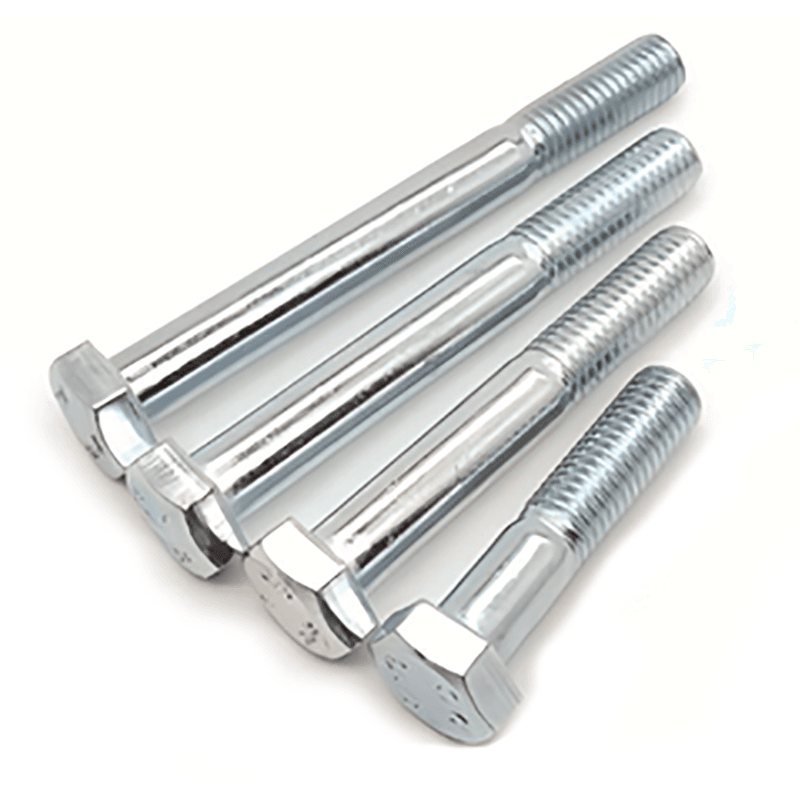
Stud Bolts vs. Bolts: Key Differences
The choice between a stud bolt and a conventional hex bolt comes down to how the joint needs to perform under pressure, vibration, and repeated maintenance.
- Head design: A hex bolt has an integral head that bears directly on one face of the joint; a stud bolt has no head and takes a nut on both ends, so clamping force is applied symmetrically.
- Load distribution: Because both ends are nutted, stud bolts spread stress more evenly across a flange face, reducing the risk of localized gasket crush or uneven bolt loading.
- Reusability: Stud bolts are easier to remove and reinstall during flange maintenance since neither end is fixed in place by a head; this matters in piping systems that see periodic inspection or gasket replacement.
- Space efficiency: Without a protruding head, stud bolts fit tighter bolt circles and confined flange arrangements where a hex head would interfere with adjacent hardware.
- Failure behavior under vibration: Double-nut stud bolt assemblies resist loosening better than single-headed bolts in equipment subject to cyclic vibration, such as compressor and pump flanges.
Different Types of Stud Bolts
Stud bolts are classified primarily by their thread configuration, which determines how they engage the mating components.
Full Thread Stud Bolts
A full thread stud bolt is threaded along its entire length. This design allows nuts to be positioned anywhere along the shank, giving flexibility when flange thicknesses vary or when the same stud needs to work across a range of joint configurations. Full thread studs are common in general-purpose flanged piping where standardization across multiple flange classes simplifies inventory.
Double End (Tap End) Stud Bolts
A double end, or tap end, stud bolt has threading only at each end, with an unthreaded shank in the middle. One end typically screws into a tapped hole in equipment such as a valve body or pump casing, while the other end passes through the mating flange and secures with a nut. The unthreaded body section adds shear strength in the load-bearing zone and reduces stress concentration compared to a fully threaded shank.
Continuous Thread Stud Bolts
Continuous thread studs are functionally similar to full thread studs but are typically supplied in longer stock lengths and cut to size on site. They are favored on large-diameter flanges and structural applications where field-adjustable stud length reduces the need to stock every exact dimension.
ASTM Stud Bolt Standards: A193 B7 and Beyond
Stud bolt material and mechanical properties are governed primarily by ASTM specifications, which define chemical composition, heat treatment, and tensile requirements for different service conditions. ASTM A193 Grade B7 is the most widely specified stud bolt grade for high-temperature and high-pressure piping, made from chromium-molybdenum alloy steel and quenched and tempered to a minimum tensile strength of 125 ksi for diameters up to 2.5 inches.
| Grade | Material | Typical Service | Max Temp (approx.) |
|---|---|---|---|
| A193 B7 | Chromium-molybdenum alloy steel | General high-temperature/high-pressure piping | 1000°F (538°C) |
| A193 B8 | Austenitic stainless steel (304) | Corrosive or sanitary environments | 1500°F (816°C) |
| A193 B16 | Chromium-molybdenum-vanadium steel | Elevated-temperature service beyond B7's range | 1100°F (593°C) |
| A320 L7 | Chromium-molybdenum alloy steel (low-temp rated) | Low-temperature and cryogenic service | -150°F (-101°C) minimum |
Stud bolts are almost always paired with matching heavy hex nuts under ASTM A194, such as A194 2H nuts for B7 studs, to ensure the nut's strength doesn't become the limiting factor in the joint.
Stud Bolt Dimensions
Stud bolt length is calculated based on flange thickness, gasket thickness, nut height, and the number of threads that should protrude beyond the nut for a secure grip, typically two to three threads. ASME B16.5 provides standard stud bolt length tables correlated to flange class and pipe size, while diameter is dictated by the flange's bolt hole size.
| Nominal Diameter | Thread Series | Threads Per Inch |
|---|---|---|
| 1/2 in | UNC | 13 |
| 3/4 in | UNC | 10 |
| 1 in | 8UN | 8 |
| 1-1/2 in | 8UN | 8 |
| 2 in | 8UN | 8 |
Because a stud bolt with the wrong length either bottoms out before achieving full clamp load or leaves excessive thread exposed beyond the nut, matching stud length to actual measured flange and gasket thickness on the job — rather than relying solely on catalog tables — remains standard practice for critical joints.
Stud Bolts for Pipe Flanges
Flange stud bolts are sized and spaced according to the flange's bolt circle, and the number and diameter required scale directly with pipe size and pressure class as defined in ASME B16.5 and B16.47. A 4-inch Class 150 raised-face flange, for example, typically takes eight 5/8-inch studs, while a 24-inch Class 600 flange can require twenty studs at 1-1/2 inches or larger — undersizing either the diameter or the quantity is one of the most common causes of gasket leakage in flanged piping.
Pipe flange stud bolts are almost always installed with a controlled, sequential tightening pattern (typically a star or crisscross pattern in multiple passes) rather than tightened one after another around the circle, since flange stud bolts loaded unevenly can tilt the flange face and cause the gasket to seal poorly on one side even when overall torque values look correct.
Stud Bolts for Pressure Vessels and Oil & Gas Service
Pressure vessel stud bolts see sustained internal pressure combined with, in many cases, cyclic thermal loading as the vessel heats and cools during process operation. This combination makes creep resistance and fatigue life as important as raw tensile strength, which is why vessel manufacturers generally specify studs by ASTM grade and by the vessel code (such as ASME Section VIII) rather than by size alone.
Oil and gas stud bolts face an added layer of demands: exposure to sour service (H2S-containing hydrocarbons), offshore salt-spray environments, and remote locations where a fastener failure means a costly shutdown rather than a quick swap. For sour service, studs are typically specified to NACE MR0175/ISO 15156 in addition to their ASTM grade, which limits hardness to reduce the risk of sulfide stress cracking.
Stainless Steel and Corrosion-Resistant Stud Bolts
Stainless steel stud bolts, most commonly ASTM A193 Grade B8 or B8M, are specified wherever a joint is exposed to moisture, chemicals, or a sanitary process environment that would corrode carbon or alloy steel over time. B8M, which includes molybdenum, offers better resistance to chloride pitting than standard B8 and is the common choice for marine and offshore piping.
One trade-off worth planning for: austenitic stainless studs have a lower yield strength than B7 alloy steel unless supplied in a strain-hardened condition (Class 2), and stainless-on-stainless threaded connections are prone to galling under high torque. Applying an anti-seize compound and controlling tightening speed reduces the risk of galling during installation and future disassembly.
Where full stainless isn't necessary, corrosion-resistant coatings such as hot-dip galvanizing, PTFE, or xylan coatings on carbon steel studs provide a lower-cost alternative for moderately corrosive outdoor or splash-zone service.
High-Strength and Heavy-Duty Stud Bolts
High-strength stud bolts are called for wherever the joint carries heavy mechanical load in addition to, or instead of, internal pressure — structural steel connections, heavy machinery mounting, and large-diameter, high-pressure-class flanges. ASTM A193 B7 (125 ksi minimum tensile) and B16 (125 ksi with added creep resistance) cover most heavy-duty industrial needs, while A320 L43 offers comparable strength for low-temperature heavy-duty service.
For the heaviest structural and equipment mounting applications, ASTM A354 Grade BD studs (150 ksi minimum tensile) step above B7, though at that strength level hydrogen embrittlement becomes a real risk if the studs are electroplated without a proper post-plating bake — a detail worth confirming with the supplier for any critical heavy-duty joint.
How to Select the Right Stud Bolts
Selecting stud bolts correctly comes down to matching five variables to the joint's actual service conditions, not just its size:
- Pressure and temperature rating: Confirm the flange or vessel's design pressure and maximum/minimum operating temperature, then select an ASTM grade rated for that range — B7 for general high-temperature service, L7 for cryogenic, B16 for elevated temperature beyond B7's limit.
- Corrosivity of the environment: Sour service, marine exposure, or aggressive chemicals push the selection toward B8M stainless or NACE-compliant grades rather than standard carbon or alloy steel.
- Diameter and length from the flange rating: Pull bolt diameter, quantity, and length directly from the applicable ASME B16.5/B16.47 table for the specific flange class and pipe size rather than estimating.
- Matching nuts and washers: Pair the stud grade with the correct ASTM A194 nut grade (e.g., 2H for B7, 8/8M for B8/B8M) so the nut isn't the weak point in the assembly.
- Installation method: High-strength or large-diameter studs in critical joints often call for controlled torque, hydraulic tensioning, or a documented bolt-up sequence rather than standard wrench tightening, which should factor into the stud and lubrication selection up front.
Related Products

PRODUCTS
Carbon Steel Fastenerss Rolling Bearings Heavy-Duty Steel Folding Trolleys Swivel Casters Bolt kitsContact
 1st Floor, Building 4, East Side, Jinger Road, Yuxin Town, Nanhu District, Jiaxing City, Zhejiang Province, China
 [email protected][email protected]
 +86-137 0583 8919+86-135 8638 0656
Copyright © Jiaxing Lanyue Metal Technology Co., Ltd. All Rights Reserved.
Privacy
Custom High-Performance Industrial Fasteners Manufacturers, Suppliers
