
 English
 Español
 Deutsch
Home / News / Industry News / Zinc-Plated vs Stainless Steel Caster Brackets: Pick the Right Corrosion Standard
-
 Lanyue Metal Technology
-
 [email protected]/[email protected]
-
 24 Hour Service - 7 Days a Week


Industry News
Home / News / Industry News / Zinc-Plated vs Stainless Steel Caster Brackets: Pick the Right Corrosion Standard
Industry News
Oct 19,2026
Zinc-Plated vs Stainless Steel Caster Brackets: Pick the Right Corrosion Standard
Caster brackets are the structural link between a wheel and the equipment it moves. They support the load, absorb shock, and determine how freely a caster can swivel. When you are selecting brackets for an industrial cart, medical equipment, or outdoor logistics equipment, the material choice often comes down to zinc-plated carbon steel versus stainless steel. The real question is not which one is generally "better," but which corrosion resistance standard your application actually requires.
Content
- 1 What Do Corrosion Resistance Standards Mean for Caster Brackets?
- 2 Zinc-Plated Carbon Steel Caster Brackets: Performance and Limitations
- 3 Stainless Steel Caster Brackets: When Alloy Composition Matters
- 4 Zinc-Plated vs. Stainless Steel: A Direct Comparison
- 5 How to Choose the Right Corrosion Resistance Level
- 6 Frequently Asked Questions
- 7 Conclusion
What Do Corrosion Resistance Standards Mean for Caster Brackets?
Corrosion resistance standards are laboratory-based ways to compare how a material or coating will behave in a corrosive environment. The most common test is the neutral salt spray (NSS) test, carried out according to methods such as ASTM B117 or ISO 9227. In this test, a sample is exposed to a continuous spray of a 5% sodium chloride solution at a controlled temperature, and the time until white rust or red rust appears is recorded.
Two visual indicators matter:
- White rust appears when the zinc coating itself has begun to corrode. It signals that a zinc-plated part is reaching the end of its protective life.
- Red rust appears when the underlying carbon steel is corroding. Once red rust becomes visible on a zinc-plated part, the steel section has lost its barrier protection.
Besides salt spray tests, you may also encounter cyclic corrosion tests, humidity tests, and electrochemical measurements. For caster brackets, salt spray hours remain the most widely quoted specification because they are easy to compare and align with coating standards such as ISO 4520 or ASTM F1941.
For stainless steel, salt spray testing usually looks for surface pitting or discoloration rather than flaking rust. Because stainless steel is a solid alloy rather than a coating, its corrosion resistance is an intrinsic material property.
Zinc-Plated Carbon Steel Caster Brackets: Performance and Limitations
Zinc plating is an electrolytic process that deposits a thin layer of zinc onto a carbon steel base. For caster brackets, typical plating thickness ranges from 5 to 15 micrometers. The zinc layer provides two forms of protection: it acts as a physical barrier, and it corrodes preferentially as a sacrificial anode if the steel becomes exposed.
In a neutral salt spray test, a standard zinc-plated bracket may show white rust after 48–120 hours. Red rust can appear from 150 to over 500 hours depending on plating thickness, passivation treatment, and post-treatment. These numbers are useful for comparing suppliers, but they do not guarantee a specific service life in real conditions.
For light-duty carts, warehouse shelving, and other indoor uses, zinc-plated carbon steel offers a strong balance of mechanical strength, cost, and corrosion resistance. It is most reliable in dry, temperature-controlled environments or in equipment that is quickly wiped down after exposure to moisture.
 Zinc Plated Carbon Steel Caster Bracket for 3/4/5 Inch WheelsThis zinc-plated carbon steel bracket suits light to medium-duty carts and shelving. Its reinforced square plate and standard 22.8mm bore support 3, 4, or 5 inch wheels with reliable, corrosion-resistant performance in dry indoor environments.View Product →
Stainless Steel Caster Brackets: When Alloy Composition Matters
Stainless steel caster brackets are machined or formed from a solid corrosion-resistant alloy. The most common grade for caster components is 304 stainless steel, which contains chromium and nickel. Chromium forms a passive oxide layer on the surface that self-repairs when scratched, giving the material its corrosion resistance.
Stainless steel does not depend on a coating, so it can be cleaned with water, mild chemicals, or steam without gradually wearing away its protection. In salt spray testing, 304 stainless steel can withstand more than 500 hours without developing red rust, and it performs far better than zinc-plated steel in highly humid, coastal, chemical, and food-processing environments.
For food-processing carts, hospital beds, or pharmacy trolleys, stainless steel also offers better hygienic surface properties. It resists staining from common disinfectants, and its smooth surface is easier to keep free of residue.
The trade-offs are higher material cost and, in some cases, slightly lower hardness than hardened carbon steel brackets. For most caster applications, however, the mechanical strength of stainless steel is sufficient, especially when the bracket is properly sized for the load.
 Stainless Steel Caster Brake BracketMade from 304 stainless steel, this brake bracket offers superior rust resistance and a reinforced bent structure for heavy-duty braking. Its standardized mounting holes ensure a universal fit for frames and pedals, ideal for demanding applications.View Product →
Zinc-Plated vs. Stainless Steel: A Direct Comparison
The table below summarizes the most important differences for engineering and procurement decisions.
| Factor | Zinc-Plated Carbon Steel | Stainless Steel (e.g., 304) |
|---|---|---|
| Protection mechanism | Thin zinc coating, sacrificial layer | Solid alloy with self-repairing passive film |
| Typical salt spray resistance | White rust in 48–120 h; red rust in 150–500+ h | 500+ h without red rust; minimal surface change |
| Relative cost | Low | 2-3 times higher |
| Suitable environments | Indoor dry or low-humidity areas | Outdoor, humid, chemical, food, and medical areas |
| Maintenance | Inspect coating; touch up scratches | Low maintenance; easy to clean |
How to Choose the Right Corrosion Resistance Level
Instead of assuming that stainless steel is always the right choice, evaluate the actual environment of the equipment. For indoor assembly lines, tool carts, or shelving with limited moisture exposure, zinc-plated carbon steel is often sufficient and more economical. If the equipment is regularly rinsed, stored outdoors, or used in coastal areas, stainless steel is the safer option.
A useful rule of thumb is to ask whether the bracket will remain dry for at least 95% of its lifetime. If the answer is yes, zinc plating is likely sufficient. If the equipment faces regular condensation, washdown, or outdoor storage, choose stainless steel or a heavy-duty galvanized alternative.
- Use zinc-plated carbon steel for dry, indoor, non-corrosive environments.
- Use stainless steel for high humidity, washdown, coastal, chemical, and food-contact areas.
- Consider heavy-duty zinc-plated forged brackets when load capacity is more important than corrosion resistance.
For high-load applications that still need cost control, a heavy-duty zinc-plated forged steel bracket can provide excellent mechanical strength with a reasonable corrosion layer. If you need a complete breakdown of caster wheel components, including brackets, axles, and bearings, review our guide to the key components of caster wheels. You can also browse our full caster component range to compare sizes and finishes.
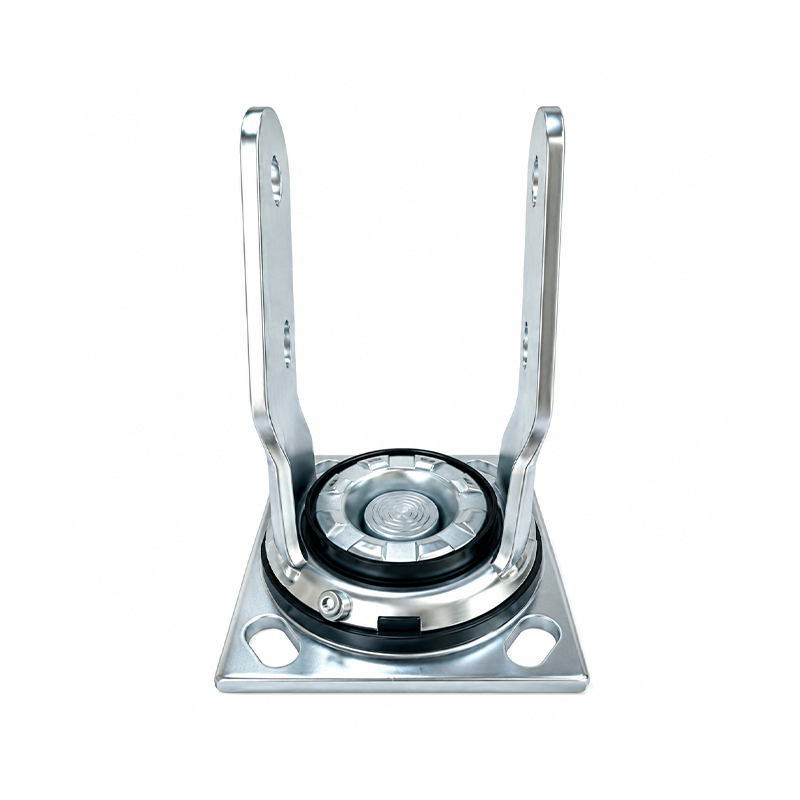 Heavy Duty Zinc Plated Forged Steel Swivel Caster Bracket for 6 inch 8 inch WheelsSelling Points: High Load Capacity Structure – Manufactured using a carbon steel forging process, allowing the bracket to withstand heavy loads in industrial and wareh...View Product →
Frequently Asked Questions
Q1: How can I tell if a caster bracket is zinc-plated or stainless steel?
Check the surface color and the supplier's specification. Zinc-plated parts have a bright silver or slightly bluish finish, while stainless steel has a softer, matte metallic luster. A magnet will stick to both carbon steel and most 304 stainless steel, so the magnet test alone is not enough.
Q2: Will a zinc-plated bracket rust if the coating is scratched?
Yes. A scratch exposes carbon steel, and the steel can begin to corrode over time if moisture is present. Stainless steel does not suffer from this problem because its passive film repairs itself. If scratches occur on zinc plating, touch-up paint or zinc-rich coating can extend the part's life.
Q3: What salt spray test hour should I specify for an indoor caster bracket?
For most indoor applications, 48–120 hours to white rust is a common specification for zinc-plated parts. For longer exposure or outdoor use, consider a thicker zinc coating, a passivation treatment, or switch to stainless steel.
Conclusion
Both zinc-plated carbon steel and stainless steel have valid places in caster bracket design. Zinc-plated brackets offer a lower-cost solution for controlled indoor environments, while stainless steel brackets deliver predictable, long-term corrosion resistance for demanding conditions. Base your decision on salt spray requirements, service environment, budget, and the mechanical strength needed for the rated load.
Related Products

PRODUCTS
Carbon Steel Fastenerss Rolling Bearings Heavy-Duty Steel Folding Trolleys Swivel Casters Bolt kitsContact
 1st Floor, Building 4, East Side, Jinger Road, Yuxin Town, Nanhu District, Jiaxing City, Zhejiang Province, China
 [email protected][email protected]
 +86-137 0583 8919+86-135 8638 0656
Copyright © Jiaxing Lanyue Metal Technology Co., Ltd. All Rights Reserved.
Privacy
Custom High-Performance Industrial Fasteners Manufacturers, Suppliers
