
 English
 Español
 Deutsch
Home / News / Industry News / How to Calculate the Exact Load Capacity Required for Industrial Swivel Casters
-
 Lanyue Metal Technology
-
 [email protected]/[email protected]
-
 24 Hour Service - 7 Days a Week


Industry News
Home / News / Industry News / How to Calculate the Exact Load Capacity Required for Industrial Swivel Casters
Industry News
Nov 04,2026
How to Calculate the Exact Load Capacity Required for Industrial Swivel Casters
Specifying an industrial swivel caster without calculating the exact load capacity first is like sizing a beam by eye: the risk is unnecessary and the failure is expensive. An undersized caster bends its fork, cracks the top plate, or locks the bearing. An oversized caster adds cost, weight, and rolling resistance. The answer is a simple, repeatable calculation that any engineer, buyer, or maintenance team can perform in minutes.
This guide explains how to calculate the exact load capacity required for industrial swivel casters step by step, clarifies the terminology behind the numbers, and connects the final result to concrete component decisions such as brackets, mounting plates, and bearings.
Content
- 1 Load Capacity Terminology You Need Before Calculating
- 2 The Core Load Capacity Formula
- 3 Step-by-Step Calculation Workflow
- 4 Dynamic Forces and Environmental Conditions That Change the Result
- 5 Worked Example: 1,200 kg Platform Cart
- 6 From Calculation to Component Selection
- 7 Five Mistakes That Invalidate the Calculation
- 8 Frequently Asked Questions
- 8.0.1 Q1: How many casters should be counted as load-bearing on a four-caster platform?
- 8.0.2 Q2: What safety factor is adequate for a manually operated cart?
- 8.0.3 Q3: Should selection always be based on dynamic load capacity?
- 8.0.4 Q4: Do swivel casters need a higher load capacity than rigid casters?
Load Capacity Terminology You Need Before Calculating
Static vs. Dynamic Load Capacity
Two ratings dominate every caster datasheet: static load capacity and dynamic load capacity. Static load capacity is the maximum force a caster can support while stationary, with only minor positional movement. Dynamic load capacity is the maximum load the caster can carry while rolling under normal operating conditions. Because motion adds bearing friction, rolling resistance, and impact energy, dynamic ratings are normally lower than static ratings. Selection for industrial equipment is almost always based on the dynamic value.
Rated Load and Safety Factor
The rated load is the manufacturer's declared safe working load under defined test conditions. The safety factor, sometimes called the service factor, is a multiplier applied to the calculated load to cover variables that a raw weight figure cannot capture: floor unevenness, starting torque, impact against dock edges, and asymmetric packing.
| Term | Meaning |
|---|---|
| Static load capacity | Maximum load supported while stationary |
| Dynamic load capacity | Maximum load during normal rolling operation |
| Rated load | Safe working load declared by the manufacturer |
| Safety factor | Multiplier covering shock, impact, and unknown conditions |
The Core Load Capacity Formula
The standard engineering approach for caster selection reduces to a single formula:
F = (W ÷ N) × SWhere:
F= required load capacity per caster (kg or N)W= total weight of equipment plus maximum payload (kg or N)N= number of load-bearing castersS= safety factor
Notice that N is the number of load-bearing casters, not the total number installed. A four-caster platform rarely distributes its load equally across all four wheels. Small variations in floor flatness, frame rigidity, and manufacturing tolerance can leave one corner of the frame effectively weightless. A conservative and widely used assumption is that three of the four casters carry the full load. Applying this rule prevents surprises on the first trip across a dock leveler.
Step-by-Step Calculation Workflow
Step 1: Establish the Total Weight
Add the empty equipment weight and the maximum payload the equipment will carry during its working life. Do not calculate for today's typical load; calculate for the heaviest load the equipment can hold, including future attachments and consumables.
Step 2: Count the Load-Bearing Casters
Use the number of casters that actually share the load, not the total number installed.
2 CastersDivide the total weight by 2
4 CastersDivide the total weight by 3
6 CastersDivide the total weight by 4 or 5
When in doubt, use the smaller number. Frame rigidity and floor flatness determine whether the more optimistic divisor is safe.
Step 3: Apply a Safety Factor
The safety factor turns a theoretical static figure into a practical engineering value. The table below lists commonly used starting points.
| Application Condition | Safety Factor Range |
|---|---|
| Manual carts, flat smooth floors, low speed | 1.2 - 1.5 |
| Powered equipment, moderate speed, occasional unevenness | 1.5 - 2.0 |
| Towed or trailed equipment, frequent impacts | 2.0 - 2.5 |
| Shock loading, dock plates, heavy vibration | 2.5 - 3.0 |
Step 4: Select Components from the Calculated Value
Compare the final figure against the dynamic load rating of the candidate caster. The chosen caster must be rated to at least the calculated requirement. Then verify that every element in the load path, the bracket, the fork, the wheel axle, and the mounting plate, carries the same rating.
Dynamic Forces and Environmental Conditions That Change the Result
Weight alone does not capture everything. The following conditions add stress to the caster and must be reflected in a larger safety factor or a higher capacity rating:
- Frequent starts and stops create torque that can exceed the steady rolling load by 25% to 50%.
- Uneven floors, expansion joints, and thresholds multiply the impact force several times the static value.
- Operating speeds above 5 km/h increase dynamic stress and internal heat in bearings.
- Elevated temperature softens some wheel tread compounds and degrades grease; corrosive or washdown areas require stainless steel or engineered plastic components.
- Lateral forces on swivel casters during turning push sideways against the kingpin and the raceway.
Environmental correction multipliers can be combined with the base safety factor. An operation that combines an uneven floor and frequent stops already justifies a factor near the top of the range.
| Condition | Additional Multiplier |
|---|---|
| Uneven warehouse floor | 1.2 |
| Frequent start-stop cycles | 1.3 |
| Speed above 5 km/h | 1.2 |
| Shock or impact loads | 1.5 |
| Corrosive or washdown environment | Use stainless steel parts |
Worked Example: 1,200 kg Platform Cart
Suppose a steel platform cart weighs 200 kg and carries a maximum payload of 1,000 kg. The total weight W is 1,200 kg. The cart uses four swivel casters, so the conservative assumption is three load-bearing casters.
F = (1,200 ÷ 3) × 1.5 = 600 kgA safety factor of 1.5 is selected because the cart crosses warehouse aisles with frequent starts and stops. The required dynamic load capacity per caster is therefore 600 kg. The table below shows how the result changes at different safety factors.
| Safety Factor | Load per Caster (kg) |
|---|---|
| 1.2 | 480 |
| 1.5 | 600 |
| 2.0 | 800 |
| 2.5 | 1,000 |
Industrial rule of thumb: when four casters are fitted, always assume that three carry the full load.
A 600 kg dynamic requirement means the bracket, wheel, bearing, and mounting plate must each be rated for at least 600 kg. At this level, a heavy-duty forged steel swivel caster bracket is a sensible choice because forging creates a dense grain structure that resists bending better than a stamped bracket of the same thickness.
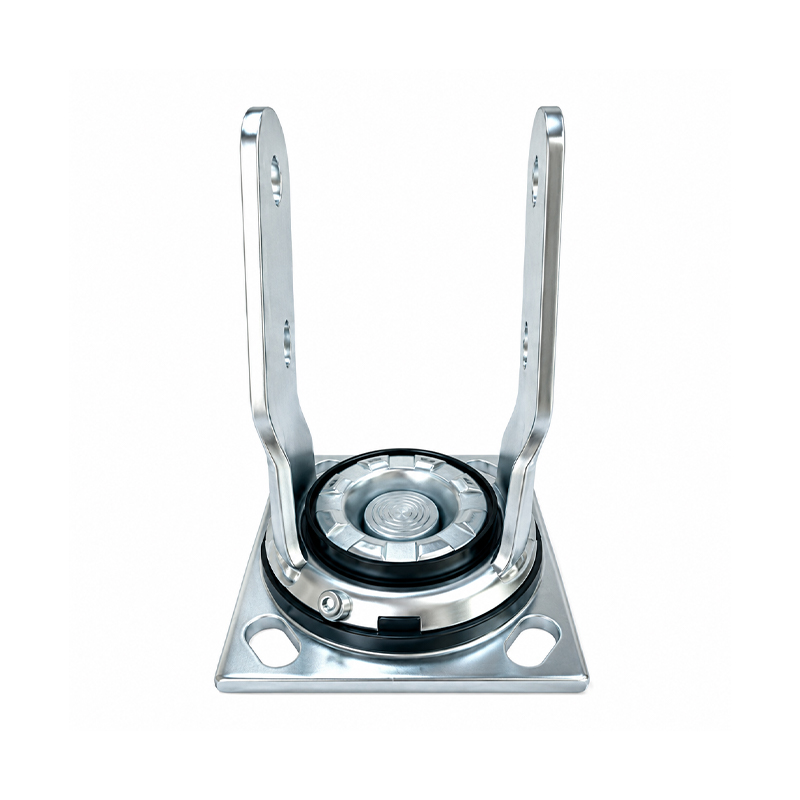
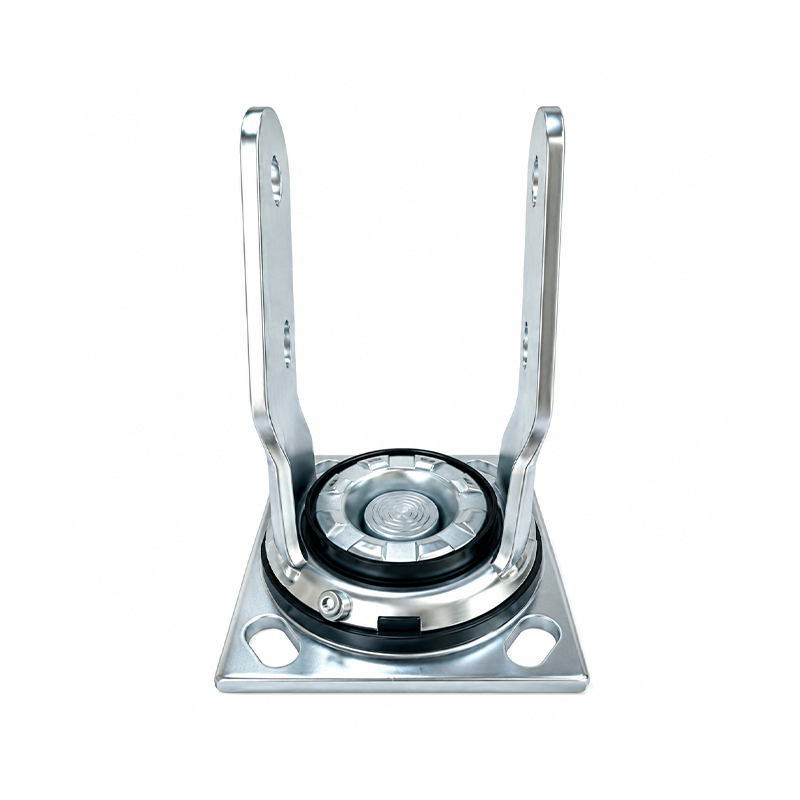 Heavy Duty Zinc Plated Forged Steel Swivel Caster Bracket for 6-8 Inch WheelsThis forged carbon steel bracket is rated for high-load industrial use, with zinc plating for corrosion resistance. Its reinforced structure suits 600 kg dynamic applications and pairs with matching wheels and mounting plates.View Product →
The bracket rating must be checked together with the wheel and mounting plate before the order is finalized.
From Calculation to Component Selection
Bracket and Fork
The bracket is the structural heart of a swivel caster. It carries the vertical load through the raceway and absorbs lateral forces during turning. For calculated capacities above roughly 500 kg, forged steel swivel brackets outperform stamped brackets in fatigue life and resistance to deformation.
Mounting Plate
The mounting plate must match the bolt pattern of the equipment and distribute the load into the frame over an adequate surface area. Check plate thickness, hole diameter, and clearance for the intended fasteners.
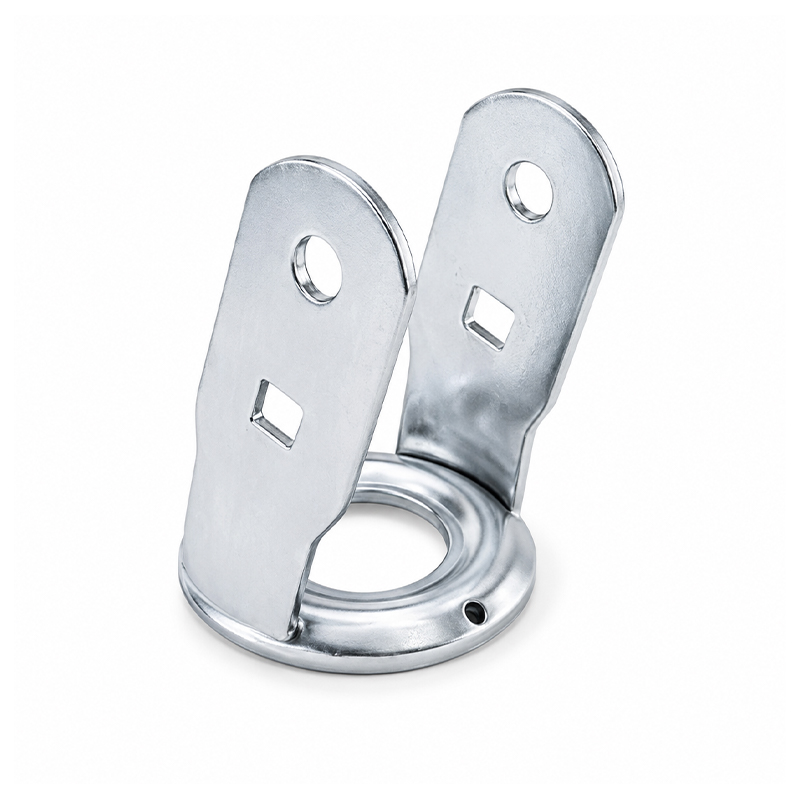
 Zinc Plated Carbon Steel Caster Mounting Plate with Slotted HolesThis stamped steel mounting plate offers four slotted holes for easy adjustment and a central hole for swivel components. It distributes load evenly, helping prevent bolt-hole elongation and frame cracking under cyclic loading.View Product →
A correctly sized mounting plate prevents bolt-hole elongation and frame cracking under cyclic loading.
Wheel and Bearing
The wheel transfers the load to the floor. Hard tread materials such as polyurethane on a rigid core roll smoothly under heavy load, while softer rubber treads absorb vibration but increase rolling resistance. The bearing must match the wheel and the load: precision ball bearings suit medium-duty applications, while roller bearings distribute stress over a larger contact area and are preferred for very heavy loads. Reviewing the key components of a caster makes it easier to understand how these parts interact.
Swivel and Rigid Combination
Combining swivel and rigid casters improves tracking and stability. On a four-caster cart, two swivel casters at the front and two rigid casters at the rear reduce the lateral load imposed on the swivel kingpins, and the calculated capacity can remain uniform across all positions.
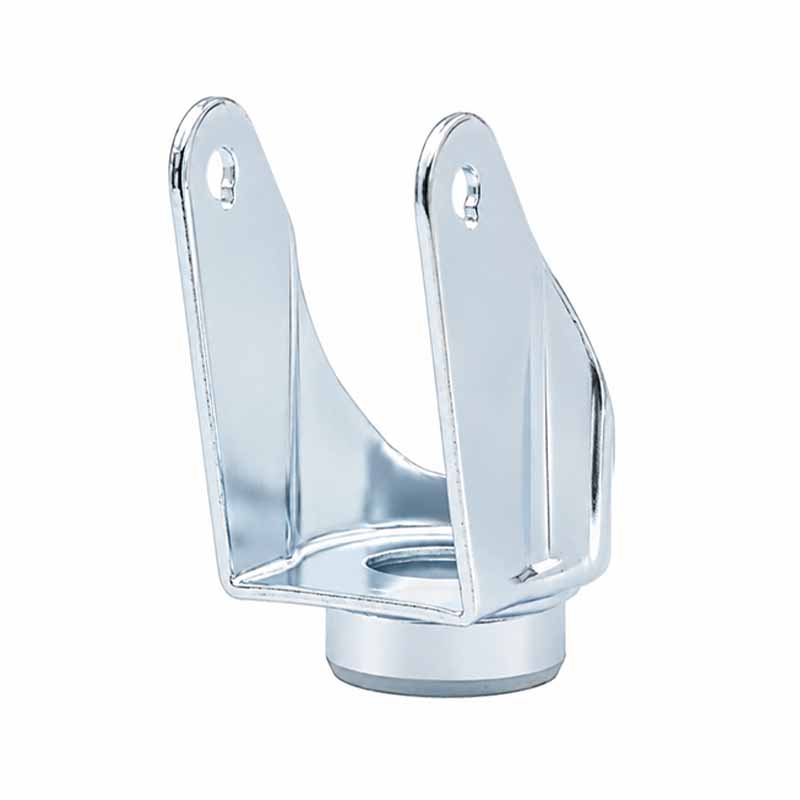
 Heavy Duty Zinc Plated Swivel Caster Bracket for 6/8 Inch WheelsA reinforced U-type double-arm bracket designed for 6 to 8 inch swivel casters. Its carbon steel structure and zinc finish provide stable support and corrosion resistance for carts, trolleys, and industrial equipment.View Product →
For large-diameter wheels and continuous industrial use, a heavy-duty swivel bracket in the 6 to 8 inch class provides the raceway strength needed to sustain the calculated load.
Five Mistakes That Invalidate the Calculation
- Dividing the total weight by all four casters instead of the load-bearing three.
- Basing the payload on a typical load rather than the worst legal load the equipment can carry.
- Ignoring shock from dock plates, thresholds, or dropped loads.
- Selecting a stamped bracket when the calculated value demands a forged or heavy-duty bracket.
- Matching the wheel load rating while ignoring the ratings of the bracket, axle, and mounting plate.
Each mistake pushes the actual stress above the rated value, which accelerates wear and can lead to complete caster failure under load.
Frequently Asked Questions
Q1: How many casters should be counted as load-bearing on a four-caster platform?
Use three. Floor flatness and frame rigidity rarely allow equal distribution across all four positions, so the conservative three-caster assumption is standard practice for caster sizing.
Q2: What safety factor is adequate for a manually operated cart?
For manual carts with smooth floors and slow speed, a factor of 1.2 to 1.5 is typically sufficient. If the load is asymmetric or the floor is uneven, move to the upper end of the range.
Q3: Should selection always be based on dynamic load capacity?
For equipment that moves, yes. Dynamic ratings reflect the real stress of rolling, turning, and starting. Static load capacity matters only for fully stationary applications or positioning frames that barely move.
Q4: Do swivel casters need a higher load capacity than rigid casters?
In practice, yes. Swivel casters experience lateral forces and raceway stress that rigid casters do not. Applying a slightly higher safety factor to swivel positions is a safe engineering practice.
Calculating the exact load capacity required for industrial swivel casters is a short, predictable process: establish the total weight, divide by the number of load-bearing casters, apply a safety factor matched to the environment, and translate the result into bracket, plate, wheel, and bearing choices. The same method works for a 100 kg instrument cart and a 5,000 kg towed trailer, and it protects people, floors, and equipment alike.
Precision is the whole game in industrial components. A correctly sized caster performs quietly, lasts for years, and keeps the operation moving. Apply the formula, verify every component, and rely on precision-engineered caster components that are built for the calculated load.
Related Products

PRODUCTS
Carbon Steel Fastenerss Rolling Bearings Heavy-Duty Steel Folding Trolleys Swivel Casters Bolt kitsContact
 1st Floor, Building 4, East Side, Jinger Road, Yuxin Town, Nanhu District, Jiaxing City, Zhejiang Province, China
 [email protected][email protected]
 +86-137 0583 8919+86-135 8638 0656
Copyright © Jiaxing Lanyue Metal Technology Co., Ltd. All Rights Reserved.
Privacy
Custom High-Performance Industrial Fasteners Manufacturers, Suppliers
