
 English
 Español
 Deutsch
Home / News / Industry News / Caster Directional Locks in Material Handling Safety: Key Roles Explained
-
 Lanyue Metal Technology
-
 [email protected]/[email protected]
-
 24 Hour Service - 7 Days a Week


Industry News
Home / News / Industry News / Caster Directional Locks in Material Handling Safety: Key Roles Explained
Industry News
Nov 09,2026
Caster Directional Locks in Material Handling Safety: Key Roles Explained
Content
- 1 What Are Caster Directional Locks and Why Do They Matter?
- 2 How Caster Directional Locks Work
- 3 The Safety Benefits of Directional Locks in Material Handling
- 4 Types of Caster Directional Locking Mechanisms
- 5 Critical Applications in Material Handling Equipment
- 6 Selecting the Right Directional Lock Caster
- 7 Maintenance and Inspection for Long-Term Safety
- 8 Frequently Asked Questions About Caster Directional Locks
- 9 The Bottom Line: Directional Locks as a Safety Investment
What Are Caster Directional Locks and Why Do They Matter?
Every day, thousands of industrial carts, platform trolleys, and material handling machines move through warehouses, factories, and distribution centers. Operators depend on this equipment to carry heavy loads safely through narrow aisles and busy work zones. One of the most overlooked components in this safety equation is the caster, and more specifically, the directional lock that determines whether a wheel travels in a straight path or turns freely.
Caster directional locks are mechanisms that restrict the swivel axis of a caster wheel. By preventing the wheel from rotating around a vertical steering axis, they keep the equipment moving in a predictable straight line. This simple function has a wide-ranging impact on material handling safety by supporting load stability, operator control, and accident prevention.
Straight-Line Tracking
Keeps carts moving along a defined path instead of drifting sideways.
Swivel Control
Prevents unintended turning during movement and loading.
Load Stability
Reduces load shift and tipping risks caused by sudden direction changes.
How Caster Directional Locks Work
To understand the safety value of caster directional locks, it helps to look at how a caster works. A standard swivel caster connects to the equipment through a vertical kingpin and a set of bearings, allowing the wheel assembly to rotate a full 360 degrees. This freedom makes the cart easy to steer, but it also creates a risk of sudden, unintended direction changes.
A directional lock removes or restricts that swivel motion. Some directional locks are built into rigid caster brackets, which have no swivel function at all. The fork is fixed directly to the mounting plate, so the wheel can only roll forward or backward in alignment with the bracket. Other directional locks are added to swivel casters as a locking pin or clamping ring that holds the swivel section in a fixed position when straight-line travel is required.
The main components in a directionally locked caster system are the mounting plate, fork or bracket, axle, and bearings. Understanding how these parts interact is the first step toward choosing a safe configuration. A detailed overview of caster wheels, brackets, and bearings explains this relationship and its effect on caster performance.
One common example of a permanent directional solution is the heavy-duty galvanized fixed caster bracket, which is designed for carts and equipment that always travel in a straight line. Its rigid construction eliminates swivel entirely, providing a stable foundation for industrial loads.
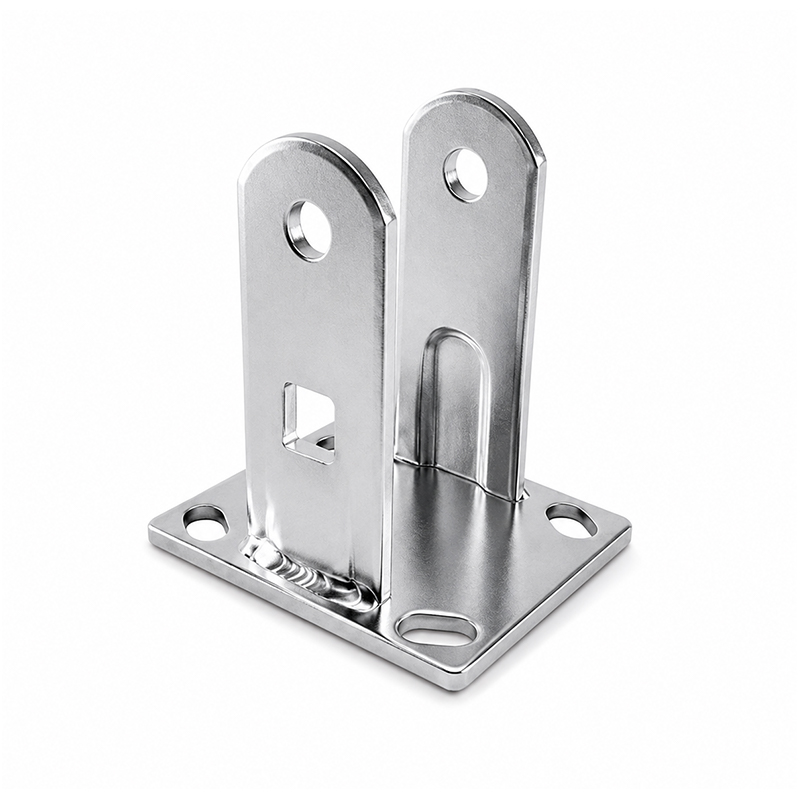 Heavy-Duty Galvanized Fixed Caster BracketThis rigid carbon steel bracket eliminates swivel for stable straight-line movement. Its zinc coating resists corrosion, and it fits 3, 4, or 5 inch wheels for industrial carts, trolleys, and shelving.View Product →
The Safety Benefits of Directional Locks in Material Handling
Directional locks improve material handling safety by removing swivel uncertainty. When a caster can turn at any moment, equipment becomes harder to control, especially on uneven floors, ramps, or under heavy loads.
- Preventing lateral drift: On a sloped floor, a free-swiveling wheel can turn sideways and cause the cart to drift. A directional lock keeps the wheel aligned with the direction of travel.
- Minimizing swerve accidents: When a swivel caster rotates suddenly while the cart is moving, it can jerk the whole machine sideways. Directional locking prevents this abrupt motion.
- Improving operator control: With all wheels oriented consistently, the operator can push or pull the cart along a predictable path without constant correction.
- Reducing tipping risk: A sudden direction change can shift the center of gravity of a loaded cart. Straight-line wheels keep the load distribution stable.
| Safety Risk | How Directional Locks Help |
|---|---|
| Lateral drift on inclined floors | Lock the wheel axis and prevent sideways sliding |
| Swerve during movement | Eliminate uncontrolled swivel rotation |
| Operator overexertion from path correction | Keep the cart tracking straight with less effort |
| Load shift from sudden direction change | Maintain stable and predictable motion |
Core safety principle: The most predictable caster is one whose direction cannot change unintentionally. Directional locks address the most common cause of caster-related accidents, namely uncontrolled swivel, by replacing randomness with predictable straight-line behavior.
Types of Caster Directional Locking Mechanisms
Manufacturers apply several approaches to achieve directional locking, and each approach has different safety implications.
Fixed and Rigid Caster Brackets
Fixed or rigid caster brackets do not have a swivel axis. The fork is fixed to the mounting plate, so the wheel can only roll in one direction. This design is strong, simple, and economical, making it a common choice for straight-running industrial trolleys and assembly line carts.
Directional Locking Pins and Positioning Pins
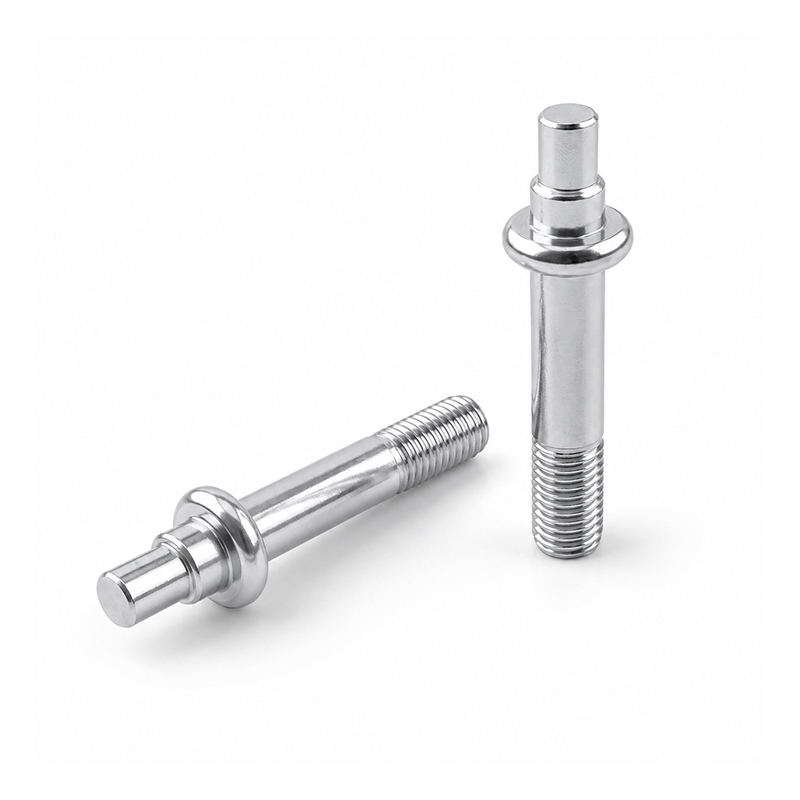
Directional locking pins allow a swivel caster to be locked into a straight-ahead position. A positioning pin engages the swivel section and prevents rotation, giving the operator the option to unlock the caster for maneuvering and lock it again for straight runs. Stainless steel positioning pins are suitable for food processing, medical, and outdoor applications where corrosion resistance is required.
 Stainless Steel Caster Positioning Pin for Swivel AssemblyThis precision-machined stainless steel pin helps align caster components during assembly and supports directional locking. It resists corrosion, making it suitable for food processing, medical, and outdoor caster applications.View Product →
Dual-Function Directional Locks
Some caster systems combine a directional lock with a wheel brake. The operator can switch between free swivel, locked direction, and locked wheel. This combination works well for equipment that must hold its position during loading and unloading, such as work platforms and heavy-duty maintenance carts.
Critical Applications in Material Handling Equipment
Directional locks are essential in applications where straight-line movement and precise alignment are safety requirements.
- Conveyor feed carts: Directional locks keep the cart aligned when docking to a conveyor or work station.
- Warehouse picking carts: In narrow aisles, straight-line tracking prevents collisions with racks and other equipment.
- Heavy-duty platform trolleys: Rigid caster brackets on the trailing end provide the stability needed for large loads.
- Assembly line feed carts: Fixed-route equipment operates safely without constant steering correction.
A common setup uses swivel casters at the front for steering and directionally locked rigid casters at the rear for stability. This combination gives the operator controlled maneuverability without sacrificing predictable tracking.
Selecting the Right Directional Lock Caster
Choosing a caster directional lock requires careful consideration of load, environment, and travel path. An incorrect selection can reduce safety even if the mechanism itself works correctly.
Load Capacity
Every bracket and caster has a rated load capacity. Exceeding that rating can cause the bracket to deform, the wheel to fail, or the locking mechanism to release unexpectedly. Always calculate the total load, including dynamic forces, and add a safety margin.
Environmental Conditions
Stainless steel components resist corrosion in wash-down and outdoor environments. Zinc-plated carbon steel offers an economical balance of strength and corrosion resistance for general indoor use. Choosing the right material prevents premature failure and keeps the lock working over time.
Floor Conditions
Uneven floors amplify the effect of swivel movement. A directional lock helps maintain stability, but wheel size and floor contact also matter. Larger wheels handle floor irregularities more smoothly, reducing stress on the locking mechanism.
| Selection Factor | Safety Recommendation |
|---|---|
| Load capacity | Include dynamic load and add a 20 percent safety margin |
| Environment | Use stainless steel for wet and corrosive areas |
| Floor type | Select wheel size based on surface smoothness |
| Directional need | Use fixed brackets for permanent straight-line travel |
For general-purpose equipment, rigid caster bracket options are available in multiple sizes and materials. Jiaxing Lanyue Metal Technology offers zinc-plated carbon steel caster brackets for 3, 4, and 5 inch wheels, providing a dependable solution for carts, racks, and trolleys that require fixed directional movement.
 Zinc Plated Carbon Steel Caster Bracket for 3/4/5 Inch WheelsThis zinc-plated carbon steel bracket offers reliable fixed movement for carts and trolleys. With precision bore and square plate design, it installs quickly and supports 3, 4, or 5 inch wheels in various industrial and retail settings.View Product →
Maintenance and Inspection for Long-Term Safety
A directional lock can only protect operators when it works reliably. Wear, dirt, and corrosion can all prevent a lock from engaging or releasing properly.
- Inspect brackets and forks regularly for cracks, deformation, or visible wear.
- Verify that locking pins and positioning pins engage fully and release smoothly.
- Lubricate swivel bearings, kingpins, and locking mechanisms according to the manufacturer's schedule.
- Check fasteners and mounting bolts for correct torque after heavy-use shifts.
- Replace wheels when tread wear affects tracking or increases vibration.
- Clean moving parts in dusty or corrosive environments to prevent binding.
If a directional lock fails during operation, the consequences can be immediate. A locking pin that disengages suddenly can allow the wheel to swerve mid-route, causing the cart to collide with racks, walls, or personnel. A preventive maintenance program is the most effective way to avoid such failures.
Frequently Asked Questions About Caster Directional Locks
Q1: What is the difference between a directional lock and a caster brake?
A caster directional lock restricts the swivel axis so the wheel cannot turn, while a caster brake stops the rotation of the wheel itself. Some casters combine both functions so the operator can lock the direction of travel and also hold the cart in a stationary position.
Q2: Can a swivel caster be converted into a directional caster?
Yes. A positioning pin or a dedicated directional lock mechanism can be added to many swivel casters to restrict rotation. In other cases, replacing the swivel bracket with a rigid caster bracket is a more permanent and reliable solution.
Q3: Are rigid casters always safer than swivel casters?
No. Rigid casters provide straight-line stability, but they reduce maneuverability. The safest configuration depends on the application. Many carts use swivel casters at the front and rigid casters at the rear to combine steering ability with stable tracking.
Q4: How often should caster directional locks be inspected?
High-usage equipment should receive a daily visual check and a more detailed inspection at least once per month. In dusty or wet factories, more frequent inspections are recommended to keep the locking mechanisms fully operational.
The Bottom Line: Directional Locks as a Safety Investment
The role of caster directional locks in material handling safety comes down to control. By preventing unwanted swivel, they make equipment predictable, reduce operator effort, and prevent accidents caused by sudden direction changes. In a busy industrial environment, that predictability is a powerful safeguard.
Selecting the right locking mechanism, matching it to the load and environment, and maintaining it diligently are all part of a responsible material handling strategy. Whether a permanent rigid bracket or a flexible positioning pin, a well-chosen directional lock protects both the equipment and the people who operate it.
Related Products

PRODUCTS
Carbon Steel Fastenerss Rolling Bearings Heavy-Duty Steel Folding Trolleys Swivel Casters Bolt kitsContact
 1st Floor, Building 4, East Side, Jinger Road, Yuxin Town, Nanhu District, Jiaxing City, Zhejiang Province, China
 [email protected][email protected]
 +86-137 0583 8919+86-135 8638 0656
Copyright © Jiaxing Lanyue Metal Technology Co., Ltd. All Rights Reserved.
Privacy
Custom High-Performance Industrial Fasteners Manufacturers, Suppliers
