
 English
 Español
 Deutsch
Home / News / Industry News / What Causes Caster Bracket Bending? How Stamped Steel Designs Solve It
-
 Lanyue Metal Technology
-
 [email protected]/[email protected]
-
 24 Hour Service - 7 Days a Week


Industry News
Home / News / Industry News / What Causes Caster Bracket Bending? How Stamped Steel Designs Solve It
Industry News
Nov 16,2026
What Causes Caster Bracket Bending? How Stamped Steel Designs Solve It
In any mobile equipment application, the caster bracket carries the entire load of the structure. It must absorb static weight, dynamic shock, and lateral forces while rolling over floors, thresholds, and dock edges that are seldom perfectly smooth. When the bracket deforms, wheel alignment is lost, rolling resistance increases, and the cart becomes difficult to push. Understanding what causes caster bracket bending is the first step toward selecting a component that will not fail in service.
Caster bracket bending is not a random event. It follows predictable physical principles involving load, stress, material properties, and geometry. Modern stamped steel bracket designs have evolved specifically to resist these failure modes. This article examines the root causes of bracket deformation and explains why stamped steel construction is the preferred solution for demanding industrial applications.
Content
- 1 What Causes Caster Bracket Bending?
- 2 How Stamped Steel Designs Solve Caster Bracket Bending
- 3 Stamped Steel vs. Cast Iron vs. Welded Fabrication
- 4 Design Features That Prevent Bracket Bending
- 5 Matching the Bracket to the Application
- 6 FAQ: Caster Bracket Bending and Stamped Steel Brackets
- 6.0.1 Q1: What is the first sign of caster bracket bending?
- 6.0.2 Q2: Can a bent caster bracket be straightened and reused?
- 6.0.3 Q3: Is stamped steel stronger than cast iron for caster brackets?
- 6.0.4 Q4: How much load can a stamped steel caster bracket support?
- 6.0.5 Q5: Does zinc plating help prevent bracket bending?
- 7 Choose a Bracket That Stays Straight Under Load
What Causes Caster Bracket Bending?
Bracket deformation almost always traces back to one of five root causes. Reviewing the key components of a caster wheel assembly can help clarify how the bracket interacts with the wheel, axle, and mounting hardware. Each source of stress below pushes the bracket beyond what its material and geometry can safely manage.
Overloading Beyond Rated Capacity
Every caster and bracket assembly carries a published load rating that assumes a centrally applied, steady load. When the actual working load exceeds that value, the bending stress in the bracket legs rises above the yield strength of the material. Permanent deformation begins immediately, typically at the junction between the leg and the mounting plate, where stress concentrates most heavily.
Impact and Shock Loading
A static load rating does not account for dynamic forces. Dropping a heavy box onto a trolley, rolling over a threshold, or crossing an expansion joint creates an instantaneous shock load that can reach two to three times the rated weight. Cast iron brackets, which are brittle, respond by cracking. Thin stamped brackets without reinforcing geometry can also deform permanently.
Uneven Weight Distribution
A caster bracket assumes the load passes directly through the center of the mounting plate. When a heavy item is placed on one corner of a cart, the load shifts toward a single caster and creates a bending moment. One leg carries most of the stress while the other remains relatively unloaded, producing a one-sided, twisted bend that quickly destroys wheel alignment.
Material and Manufacturing Defects
Cast brackets can contain internal porosity, inconsistent wall thickness, or soft spots from improper heat treatment. Welded fabricated brackets can suffer from weld porosity, incomplete penetration, and heat-affected zones with reduced strength. Even stamped brackets fail prematurely if the steel grade is too low or the bend radii are too tight for the material being formed.
Improper Mounting and Misalignment
Installation errors are a frequent and often overlooked cause of bracket bending. If the mounting surface is uneven or the bolts are torqued in the wrong sequence, the bracket is twisted before it supports any load. A misaligned axle also creates continuous side loads, adding residual stress on top of the working stress and reducing the margin against bending.
How Stamped Steel Designs Solve Caster Bracket Bending
Stamped steel has become the standard material technology for industrial caster brackets because it directly addresses the failure mechanisms described above. The process, the material, and the achievable geometry combine to create a bracket with high bending resistance and excellent reproducibility.
Key insight: Stamping work-hardens the steel exactly at the bend lines, where caster bracket bending stress concentrates most heavily.
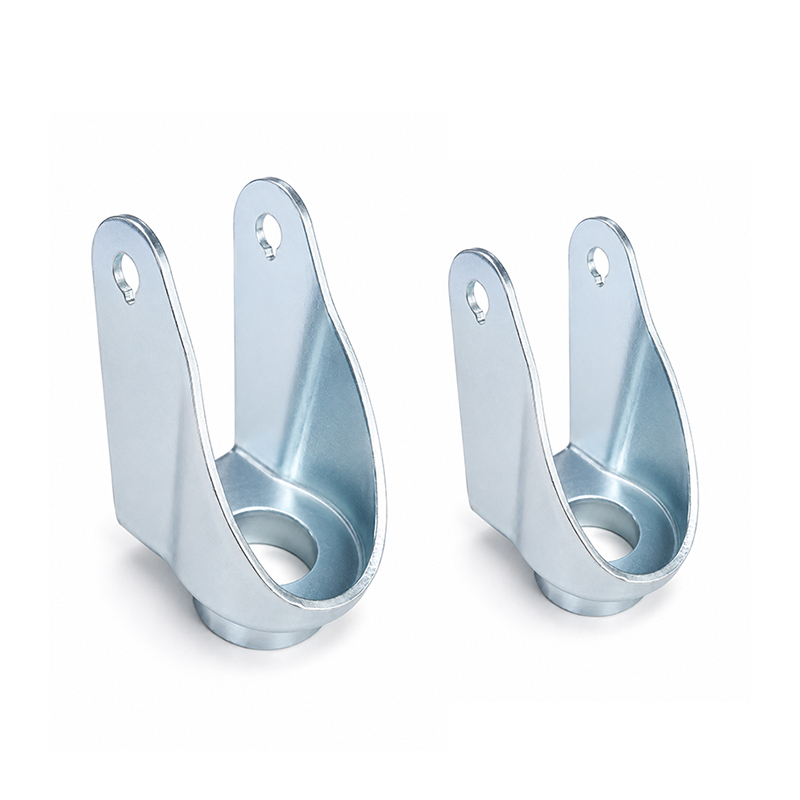
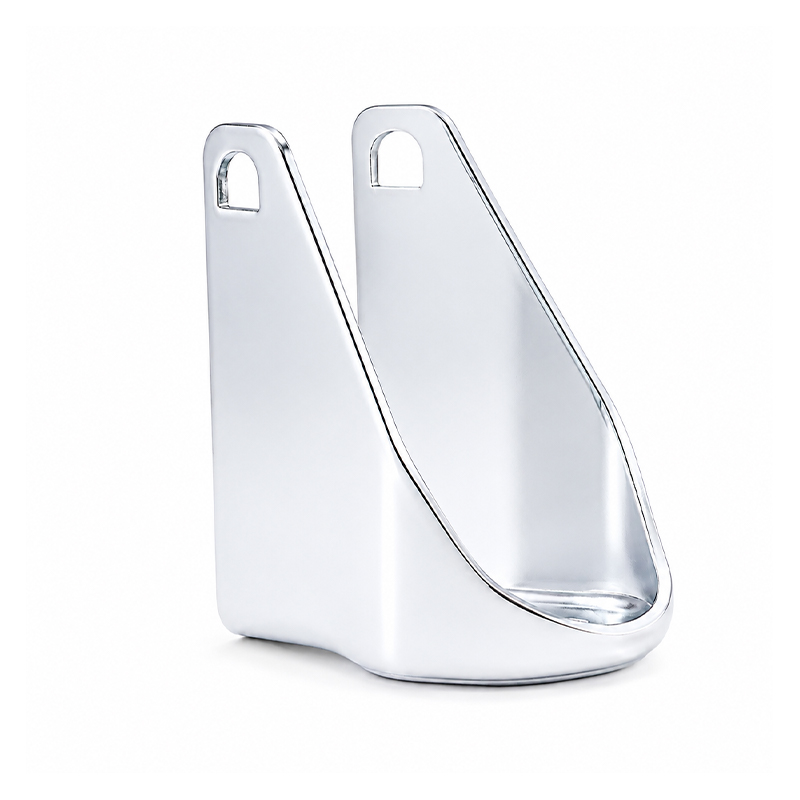 Heavy Duty U-Shaped Carbon Steel Caster Mounting Bracket, Zinc PlatedThis stamped bracket uses work-hardening at bend lines to add strength exactly where caster loads concentrate, while the zinc plating protects against rust and keeps installation precise.View Product →
Work Hardening Where Stress Is Highest
Stamped brackets are formed from cold-rolled steel coil with a precise, consistent thickness and a clean grain structure. During stamping, the steel is plastically deformed at the bend lines, raising the yield strength in those exact zones. Unlike a cast part, a stamped bracket concentrates additional strength precisely where bending is most likely to occur.
Repeatable Geometry That Eliminates Weak Points
Every stamped bracket produced from the same die set is identical to the last. Features that resist bending, such as continuous side flanges, gussets, and generous bend radii, are locked into the tooling. There is no weld seam to crack, no casting void to weaken the cross-section, and no machining variation to create a stress riser.
High-Strength Steel With an Excellent Strength-to-Weight Ratio
Stamped brackets are commonly produced from high-strength low-alloy steels with significantly higher yield strength than conventional structural grades. Because the geometry carries much of the stiffness, the bracket remains light while outperforming much heavier cast iron parts. A lighter undercarriage also increases payload capacity and reduces push effort.
Predictable Quality in High-Volume Production
The stamping process is fast, repeatable, and economical at high volume. Once the die is validated and process parameters are locked, quality is assured by the process itself. For equipment builders needing thousands of identical brackets per month, this translates into fewer rejects, fewer warranty claims, and fewer field failures.
Stamped Steel vs. Cast Iron vs. Welded Fabrication
To understand why stamped steel brackets resist bending so well, it helps to compare them with the alternatives. The table below summarizes the differences across the properties that matter most for caster bracket performance.
| Property | Stamped Steel | Cast Iron | Welded Fabrication |
|---|---|---|---|
| Material consistency | High | Moderate | Low |
| Strength-to-weight ratio | Excellent | Moderate | Good |
| Impact resistance | Excellent | Low | Moderate |
| Dimensional repeatability | Excellent | Low | Moderate |
| Deformation resistance | High | Low | Moderate |
| Production cost at volume | Low | Moderate | High |
| Corrosion protection | Excellent | Moderate | Moderate |
Across these criteria, stamped steel delivers the best balance of mechanical performance, weight, and manufacturing economy. Cast iron retains a place in very low speed, static installations where its mass is beneficial. Welded fabrication is practical for small batches or unusual geometries, but it introduces weld risks that a properly designed stamping die eliminates.
Design Features That Prevent Bracket Bending
Not every stamped bracket is engineered to the same standard. When specifying a bracket for a demanding application, check for the following features that directly influence bending resistance.
- A clearly specified steel grade with a published yield strength rather than an unnamed low-cost material.
- Sufficient material thickness matched to the rated load, supported by stiffening geometry such as side flanges and ribs.
- Generous bend radii at all formed corners to prevent micro-cracks during forming and under cyclic loading.
- A mounting plate thick enough to resist local dimpling under bolt-head pressure.
- Gussets or reinforcement at the transition from legs to mounting plate, the zone where bending stress peaks.
- A durable finish such as hot-dip galvanizing or zinc plating to prevent rust from thinning the steel over time.
Geometry alone is not enough. The bracket must also match the wheel size, axle diameter, and brake configuration of the caster system. A bracket that creates excessive side load on the axle will fail regardless of how well it resists bending. That is why working with a manufacturer that produces caster components as a coordinated system is so valuable.
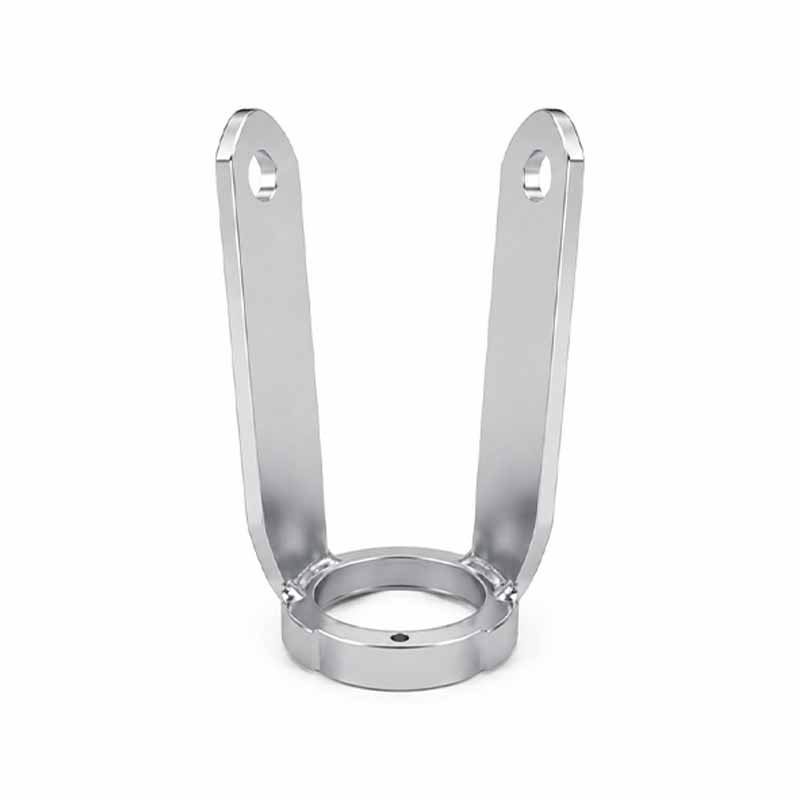
 Zinc Plated Carbon Steel Caster Fork Bracket for 3/4/5 Inch WheelsDesigned for 3, 4, and 5 inch caster wheels, this rigid bracket offers stable support with clear mounting holes and a corrosion-resistant finish, ideal for carts and trolleys.View Product →
Matching the Bracket to the Application
Selecting the right bracket technology also depends on the operating environment and the duty profile of the equipment.
- Indoor warehousing and light logistics: economical zinc-plated steel brackets with standard flange geometry.
- Outdoor or humid environments: galvanized or stainless stamped brackets with corrosion-resistant coatings.
- Heavy-duty transport: thicker gauge brackets with deep side flanges and hardened or bushed axle bores.
- Impact-prone applications: brackets with reinforced gussets and high-strength steel grades.
- Position-critical installations: fixed brackets with precision-formed mounting plates to maintain exact wheel alignment.
A fixed caster bracket is simpler than a swivel bracket because it has no raceway or rotation mechanism. That simplicity makes it easier to design a very stiff, deformation-resistant structure. For carts that travel mostly in a straight line, a well-designed rigid bracket is often the most reliable choice.
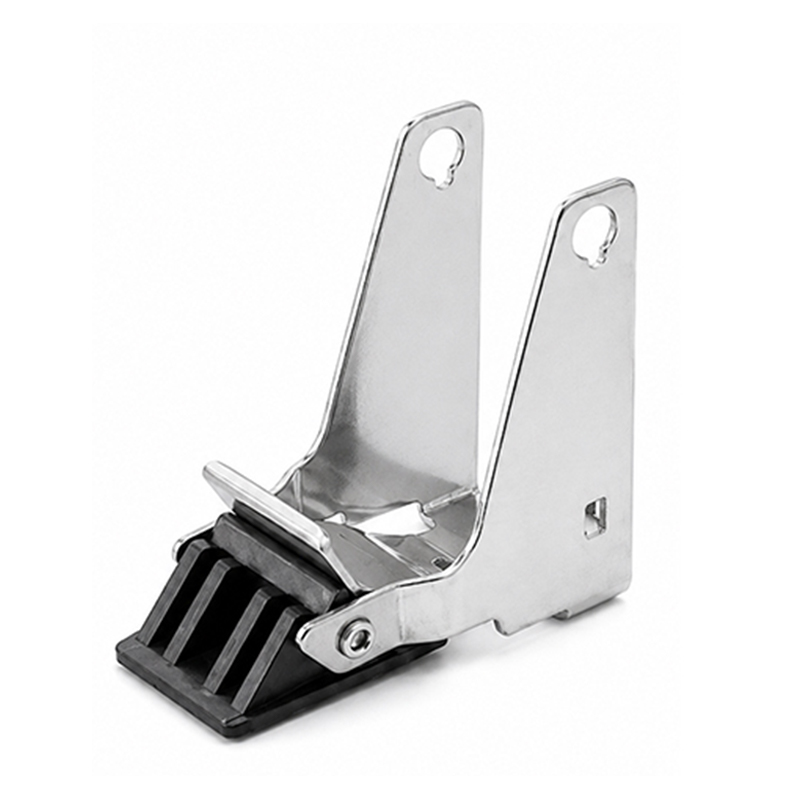
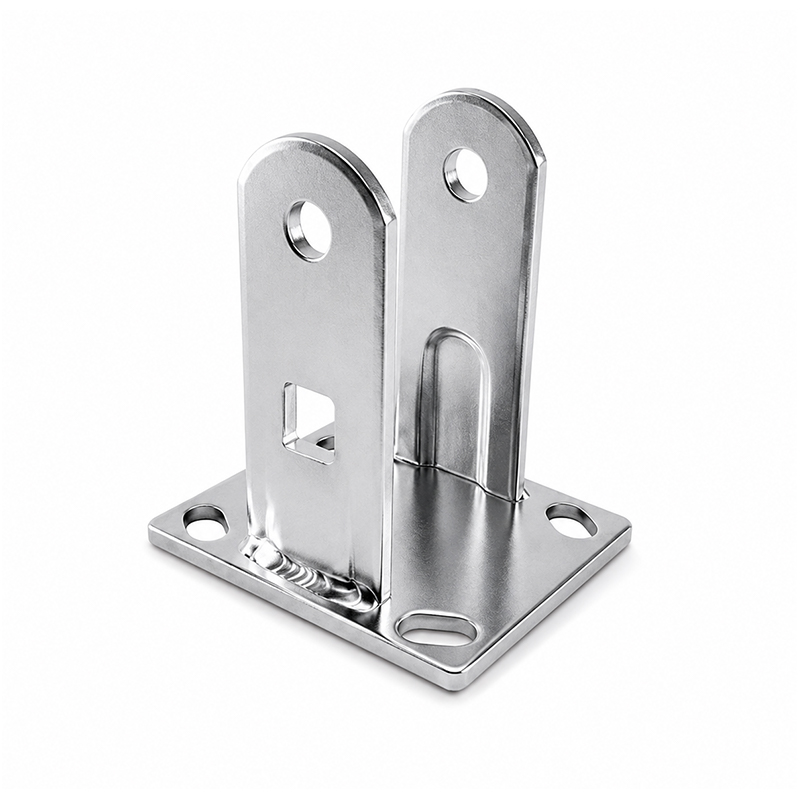 Heavy-Duty Galvanized Fixed Caster BracketA one-piece formed rigid bracket that avoids weld weak points, supports multiple wheel sizes, and keeps wheel alignment stable to reduce uneven wear and vibration in straight-line carts.View Product →
FAQ: Caster Bracket Bending and Stamped Steel Brackets
Q1: What is the first sign of caster bracket bending?
Uneven wheel wear is usually the first symptom. When the bracket deforms, the axle tilts, so one side of the wheel carries more load and the tread wears faster on that side. A wobble or increased rolling resistance is another early indicator.
Q2: Can a bent caster bracket be straightened and reused?
A slightly bent bracket can sometimes be pressed back into shape, but the deformation has already work-hardened the steel and reduced its ductility. The straightened bracket is weaker than the original and will likely fail again, often sooner. For safety-critical equipment, replacement is always recommended.
Q3: Is stamped steel stronger than cast iron for caster brackets?
In nearly all practical applications, yes. Stamped high-strength steel has a better strength-to-weight ratio, a more consistent grain structure, and far better impact resistance than cast iron. Cast iron is brittle and prone to cracking under shock loads that a stamped bracket absorbs without permanent deformation.
Q4: How much load can a stamped steel caster bracket support?
Load capacity depends on steel grade, material thickness, bracket geometry, and axle size. Heavy-duty stamped brackets in industrial casters are commonly rated from several hundred to over one thousand kilograms per caster, assuming a centrally applied load. Always verify the manufacturer's published rating for the specific model.
Q5: Does zinc plating help prevent bracket bending?
Zinc plating protects steel from corrosion but does not directly add bending strength. However, corrosion pits act as stress concentrators and gradually reduce the effective cross-section. A quality coating keeps the steel at full strength and indirectly prevents bending failures in humid or outdoor environments.
Choose a Bracket That Stays Straight Under Load
Caster bracket bending is a preventable failure. Overload, impact, uneven loading, material defects, and mounting errors are all predictable conditions that can be designed against. Stamped steel brackets solve the problem by combining work-hardened bend zones, consistent material quality, high-strength steel grades, and repeatable precision geometry into a component that genuinely resists deformation.
When you specify a bracket, look beyond the price and check the material specification, the stiffening details, and the manufacturer's engineering capability. A company like Lanyue Metal, which manufactures caster components and precision metal parts as its core business, understands exactly how those details affect real-world performance. Choosing the right stamped bracket is one of the most effective ways to keep carts, trolleys, and industrial equipment in service with minimal maintenance.
Related Products


PRODUCTS
Carbon Steel Fastenerss Rolling Bearings Heavy-Duty Steel Folding Trolleys Swivel Casters Bolt kitsContact
 1st Floor, Building 4, East Side, Jinger Road, Yuxin Town, Nanhu District, Jiaxing City, Zhejiang Province, China
 [email protected][email protected]
 +86-137 0583 8919+86-135 8638 0656
Copyright © Jiaxing Lanyue Metal Technology Co., Ltd. All Rights Reserved.
Privacy
Custom High-Performance Industrial Fasteners Manufacturers, Suppliers
