
 English
 Español
 Deutsch
Home / News / Industry News / Top Plate vs. Bolt Hole Mounting: How to Select the Right Caster Mounting Style
-
 Lanyue Metal Technology
-
 [email protected]/[email protected]
-
 24 Hour Service - 7 Days a Week


Industry News
Home / News / Industry News / Top Plate vs. Bolt Hole Mounting: How to Select the Right Caster Mounting Style
Industry News
Nov 23,2026
Top Plate vs. Bolt Hole Mounting: How to Select the Right Caster Mounting Style
Casters are a simple yet vital component of industrial equipment. They allow carts, racks, machines, and handling devices to move freely while supporting substantial loads. However, selecting the right caster involves more than wheel diameter and load rating. The mounting style, which is the interface between the caster assembly and the equipment frame, plays an equally important role in safety, stability, and long-term durability.
Two mounting styles dominate the industrial market: top plate mounting and bolt hole mounting. Although both can be found in similar applications, they differ in structure, load distribution, installation effort, and suitability for different equipment designs. Understanding these differences helps engineers, purchasing professionals, and maintenance teams make informed decisions.
This guide compares top plate and bolt hole caster mounting, explains the strengths and limitations of each, and provides practical selection criteria. If you are new to caster engineering, it is useful to review the key components of a caster before examining mounting options in detail.
Content
- 1 Understanding Caster Mounting Basics
- 2 Top Plate Mounting: Features, Advantages, and Applications
- 3 Bolt Hole Mounting: Features, Advantages, and Applications
- 4 Top Plate vs. Bolt Hole Mounting: Key Differences
- 5 How to Select the Right Caster Mounting Style
- 6 Mounting Components and Quality Considerations
- 7 Frequently Asked Questions
- 7.0.1 Q1: What is the difference between top plate and bolt hole caster mounting?
- 7.0.2 Q2: Which mounting style is better for heavy loads?
- 7.0.3 Q3: Can a top plate caster be converted to bolt hole mounting?
- 7.0.4 Q4: Do bolt hole mounted casters require special installation tools?
- 7.0.5 Q5: What material should be used for caster mounting plates in wet environments?
Understanding Caster Mounting Basics
The mounting style determines how the caster transfers the equipment load to the wheels and how the caster is secured to the equipment structure. A properly designed mounting interface ensures even load transfer, prevents fasteners from loosening during movement, and simplifies replacement and maintenance.
Caster mounting can be grouped into two broad families: mounting through a horizontal top plate and mounting directly through bolt holes in the caster bracket or frame structure. The choice between them affects the following factors:
- Installation method and required tool access
- Overall equipment height
- Load distribution across the mounting area
- Compatibility with different frame geometries
- Replacement effort when the caster reaches the end of its service life
Both styles depend on fasteners. The bolts, nuts, and washers used for mounting must be selected according to the load class and the vibration characteristics of the application.
Top Plate Mounting: Features, Advantages, and Applications
Top plate mounting is the most widely used caster mounting style in industrial equipment. In this design, a flat steel plate is fixed to the upper part of the caster frame. The plate contains pre-drilled holes or slotted openings that accept mounting bolts from the equipment side. During manufacturing, the plate is riveted, welded, or bolted to the swivel section of a swivel caster or to the frame of a rigid caster.
From a structural point of view, the top plate creates a broad and stable interface between the caster and the equipment. Because the plate provides a large surface area, it distributes the equipment load over a wider region and reduces stress concentration around individual bolt holes.
Key Features
- Pre-drilled bolt patterns with two, three, or four holes
- Slotted holes allow small adjustments during installation
- Available in carbon steel, stainless steel, and zinc-plated versions
- Compatible with standard hex bolts, lock washers, and nuts
- Plate thickness and dimensions are matched to the caster load class
Advantages
The main advantage of top plate mounting is installation simplicity. The equipment only needs a flat and clean mounting surface; the caster is placed in position and secured with bolts through the plate holes. In most cases, no special machining is required on the equipment frame.
Top plate mounting also offers strong compatibility. Many equipment builders standardize on common mounting hole patterns, allowing one caster model to serve multiple product lines. When a caster needs to be replaced, a technician can unbolt the worn unit and install a new one with the same pattern in a matter of minutes.
Common Applications
- Industrial push carts and platform trucks
- Medical carts and hospital equipment
- Display racks and mobile shelving systems
- Warehouse handling equipment
- Machine bases and mobile workstations
 Zinc Plated Carbon Steel Caster Mounting Plate with Slotted HolesThis mounting plate suits top plate caster attachment, featuring four slotted holes for position adjustment. Its stamped carbon steel structure and zinc finish support stable swivel movement and long-term use on carts, trolleys, and logistics equipment.View Product →
Bolt Hole Mounting: Features, Advantages, and Applications
Bolt hole mounting refers to caster configurations in which the caster is secured directly through bolt holes machined or formed in the caster bracket structure, rather than through a separate top plate. In this design, the caster frame itself provides the mounting interface. Common examples include U-shaped brackets, angle brackets, and extended mounting lugs that accept bolts directly.
This mounting style is frequently used in heavy-duty equipment where the caster must be attached to a structural frame member. The mounting bolts pass through aligned holes in the equipment frame and the caster bracket, producing a direct and rigid connection between the two parts.
Key Features
- Bolt holes located on the bracket body, mounting lugs, or horizontal flange
- Eliminates the need for a separate top plate in many configurations
- Commonly produced as U-shaped brackets or angle brackets
- Suitable for flat surfaces, tube stock, and structural profiles
- Available in zinc-plated carbon steel and stainless steel
Advantages
Bolt hole mounting can reduce the overall height of the equipment because it avoids the added thickness of a separate top plate. This is valuable for low-profile cart designs and machines with limited vertical space.
The direct connection also produces a short and stiff load path. Because the bolts engage directly with the equipment frame, the mounting behaves as a more rigid assembly. This is beneficial for applications that experience impact loads, lateral forces, or frequent movement over uneven surfaces.
Design flexibility is another benefit. Equipment frame holes can be positioned precisely to match the caster bracket holes, allowing a high level of integration. OEM manufacturers often prefer this approach when they control the frame design and want to reduce the number of separate parts in the assembly.
Common Applications
- Heavy-duty industrial trucks and trailers
- Conveyor and automation equipment supports
- Towing and jacking equipment
- Custom material handling systems
- Equipment with tubular or structural steel frames
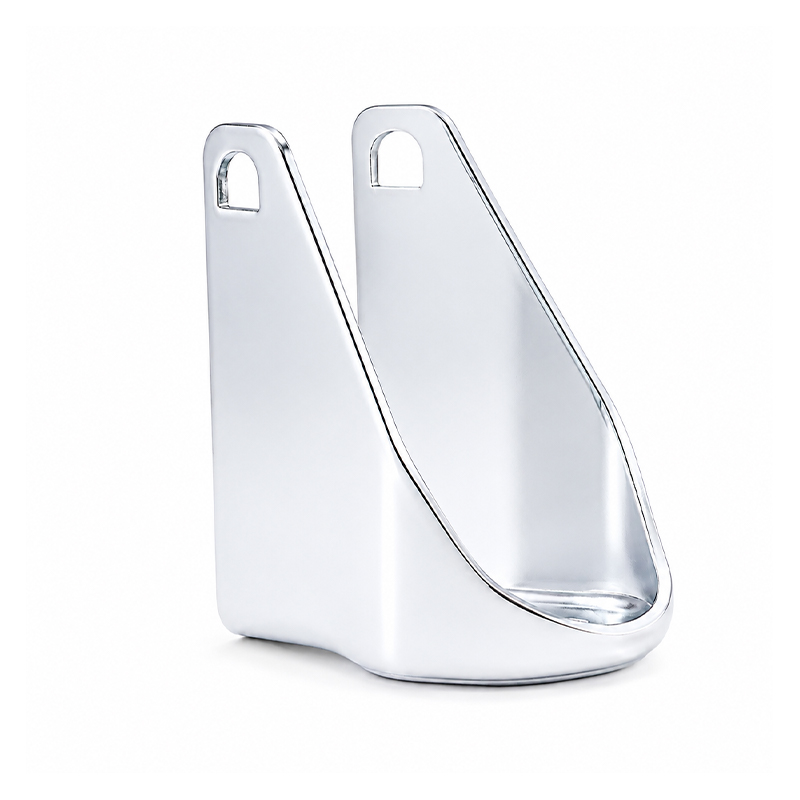 Heavy Duty U-Shaped Carbon Steel Caster Mounting Bracket Zinc PlatedDesigned for bolt hole mounting, this U-shaped bracket provides a low-profile, high-strength connection. Stamped carbon steel with zinc plating offers rust resistance and precise arc-shaped holes, making it reliable for industrial casters in warehouse and machinery applications.View Product →
Top Plate vs. Bolt Hole Mounting: Key Differences
To help you compare the two mounting styles side by side, the table below summarizes the most important differences.
| Factor | Top Plate Mounting | Bolt Hole Mounting |
|---|---|---|
| Load distribution | Even across the plate surface | Concentrated around bracket holes |
| Installation complexity | Low; requires only a flat surface | Higher; frame holes must be aligned |
| Equipment height | Adds plate thickness | Lower profile possible |
| Mounting flexibility | Standardized patterns | Custom hole positions |
| Replacement ease | High; quick unbolt and swap | Depends on frame access |
| Typical applications | Carts, racks, medical equipment | Heavy-duty and structural frames |
These differences are not absolute. Some caster designs combine both approaches, such as a rigid bracket that accepts either a top plate or direct bolting. The final decision should be based on the equipment structure, operating load, and maintenance workflow.
How to Select the Right Caster Mounting Style
Selecting the correct mounting style requires a systematic review of the equipment design, load conditions, and operating environment. Use the following criteria as a decision guide.
- Examine the equipment frame. Inspect the mounting location. If the equipment has a flat bottom panel or shelf, top plate mounting offers the simplest installation. If the frame consists of tubes, channels, or structural sections, bolt hole mounting may integrate more cleanly.
- Consider the total height. For low-profile carts and machines with strict height limits, bolt hole mounting avoids the additional height of a top plate on the assembly.
- Evaluate load and impact conditions. Heavy loads and repeated impacts demand a rigid connection. Both styles work when the bracket, plate, and fasteners are sized correctly, so match the components to the actual load class.
- Plan for removal and replacement. Casters wear out over time. Top plate mounting usually allows a straightforward replacement without modifying the frame. Bolt hole mounting requires convenient access to the bracket bolts.
- Check the operating environment. For wet, corrosive, or hygienic settings, stainless steel mounting plates and brackets are the safer choice. Zinc-plated carbon steel offers good value in dry indoor environments.
- Standardize across product models. If multiple equipment models share a platform, choose one mounting style and one hole pattern to simplify inventory management and reduce assembly errors.
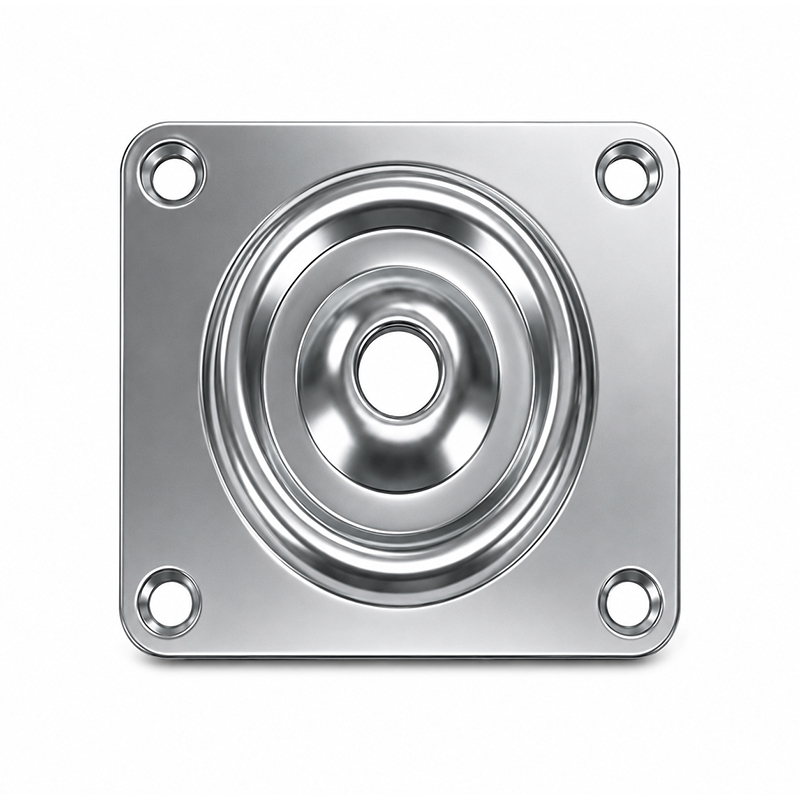
 304 Stainless Steel Swivel Caster Mounting Plate with Raised HubBuilt for swivel caster installation, this square plate features a raised hub and four corner holes for secure mounting. Made from 304 stainless steel, it resists corrosion and is ideal for shopping carts, tool carts, and mobile equipment bases where durability matters.View Product →
A useful rule of thumb: choose top plate mounting for equipment with a flat base and common load requirements; choose bolt hole mounting for structural frames, low-profile designs, and heavy-duty conditions.
Mounting Components and Quality Considerations
The reliability of a caster mounting depends not only on the mounting style but also on the quality of the components used in the interface. A thin or poorly manufactured plate can deform under load, and low-grade fasteners can loosen during operation.
Key elements to verify include:
- Plate and bracket material. Carbon steel plates with zinc plating provide good strength and corrosion resistance. Stainless steel plates suit food processing, medical, and outdoor applications.
- Hole accuracy. Deburred and precisely positioned holes prevent bolt misalignment and avoid stress concentration.
- Welding and riveting quality. The connection between the plate or bracket and the caster frame must have full structural integrity.
- Fastener selection. The correct bolt grade, length, and torque are essential. Refer to the engineering guide on carbon steel fastener selection when specifying mounting hardware.
- Surface treatment. Zinc plating, passivation, and other protective finishes extend service life in demanding environments.
For OEM and custom projects, manufacturers with in-house metal processing capabilities can supply mounting plates and brackets that match customer drawings. Custom hole patterns, special plate thicknesses, and specified surface finishes can be arranged for batch production.
Frequently Asked Questions
Q1: What is the difference between top plate and bolt hole caster mounting?
Top plate mounting uses a pre-drilled horizontal plate attached to the caster frame, and the equipment is bolted to the plate. Bolt hole mounting secures the caster directly through holes in the caster bracket or mounting lugs, without a separate plate.
Q2: Which mounting style is better for heavy loads?
Both styles can support heavy loads when the bracket, plate, and bolts are properly sized. Bolt hole mounting creates a direct and rigid load path, which suits structural frames. Top plate mounting distributes the load over a larger surface area, which benefits flat-frame equipment.
Q3: Can a top plate caster be converted to bolt hole mounting?
Conversion is usually not practical because the caster frame and its mounting interface are designed during manufacturing. The correct mounting style should be selected at the time of ordering rather than modified later.
Q4: Do bolt hole mounted casters require special installation tools?
In most cases, standard wrenches and sockets are sufficient. The main requirement is access to the rear side of the mounting surface so that nuts and lock washers can be fitted and torqued correctly.
Q5: What material should be used for caster mounting plates in wet environments?
Stainless steel is recommended for wet, corrosive, or hygienic environments. For dry indoor applications, zinc-plated carbon steel provides dependable performance at a lower cost.
Choosing between top plate and bolt hole mounting is not a one-size-fits-all decision. Top plate mounting is the default choice for most applications because of its easy installation, broad compatibility, and simple replacement. Bolt hole mounting is the preferred option in heavy-duty and space-constrained designs where direct frame integration matters.
Evaluate your equipment frame, load conditions, height budget, and maintenance workflow before placing an order. When the correct mounting style is combined with well-made components and properly torqued fasteners, the caster will deliver reliable performance throughout its service life.
Related Products


PRODUCTS
Carbon Steel Fastenerss Rolling Bearings Heavy-Duty Steel Folding Trolleys Swivel Casters Bolt kitsContact
 1st Floor, Building 4, East Side, Jinger Road, Yuxin Town, Nanhu District, Jiaxing City, Zhejiang Province, China
 [email protected][email protected]
 +86-137 0583 8919+86-135 8638 0656
Copyright © Jiaxing Lanyue Metal Technology Co., Ltd. All Rights Reserved.
Privacy
Custom High-Performance Industrial Fasteners Manufacturers, Suppliers
