
 English
  Español
  Deutsch
 Home / News / Industry News / Dynamic vs Static Load Ratings in Rolling Bearing Selection for Material Handling
-
 Lanyue Metal Technology
-
 [email protected]/[email protected]
-
 24 Hour Service - 7 Days a Week


Industry News
Home / News / Industry News / Dynamic vs Static Load Ratings in Rolling Bearing Selection for Material Handling
Industry News
Oct 01,2026
Dynamic vs Static Load Ratings in Rolling Bearing Selection for Material Handling
Material handling equipment operates in demanding environments. Conveyor rollers, caster wheels, folding trolleys, and lift mechanisms all depend on rolling bearings to carry loads while maintaining smooth, reliable rotation. Choosing the right bearing requires more than matching shaft diameters and housing dimensions. Engineers and procurement teams must understand two fundamental ratings published for every bearing: the dynamic load rating (C) and the static load rating (C0). These two values define how a bearing behaves under motion and at rest, and confusing them is one of the most common causes of premature bearing failure in industrial equipment. This article explains both ratings, how they interact, and how to apply them when selecting rolling bearings for material handling applications.
Content
- 1 What Are Dynamic and Static Load Ratings?
- 2 Why Load Ratings Matter in Material Handling
- 3 Dynamic Load Rating (C) in Practice
- 4 Static Load Rating (C0) in Practice
- 5 Dynamic vs. Static: Which Rating Drives Your Selection?
- 6 Material Handling Application Examples
- 7 Frequently Asked Questions
- 8 Conclusion
What Are Dynamic and Static Load Ratings?
Every rolling bearing manufacturer publishes two distinct load ratings in its product specifications. The dynamic load rating (C) indicates the constant load a bearing can support while rotating, under which the bearing achieves an expected fatigue life. The static load rating (C0) indicates the maximum load a non-rotating or slowly oscillating bearing can withstand without permanent deformation of the raceways or rolling elements.
| Parameter | Dynamic Load Rating (C) | Static Load Rating (C0) |
|---|---|---|
| Definition | Constant radial load for a rated life of one million revolutions | Maximum stationary load without permanent deformation |
| Failure mode addressed | Fatigue spalling under continuous rotation | Brinelling and raceway indentation at rest |
| Typical applications | Motors, conveyor rollers, gearboxes | Caster wheels, parked trolleys, shock-loaded joints |
Why Load Ratings Matter in Material Handling
Material handling equipment rarely runs under perfectly steady loads. Forklift wheels accelerate and brake, conveyor rollers start and stop, caster wheels carry heavy loads over uneven floors, and trolleys are loaded while stationary before being pushed into motion. Each scenario applies either dynamic or static stress to the bearing, and the two ratings address different failure modes.
- If a bearing is selected for dynamic rating alone, static capacity may be insufficient for peak loads encountered during loading, parking, or impact.
- If a bearing is selected for static rating alone, the equipment may suffer premature fatigue in continuous operation.
- Reliable selection always checks both ratings against the real duty cycle.
Key point: Dynamic rating predicts how long a rotating bearing lasts; static rating protects a stationary or shock-loaded bearing from permanent damage.
Dynamic Load Rating (C) in Practice
The dynamic load rating is derived from the bearing's internal geometry, steel quality, heat treatment, and manufacturing precision. Under laboratory conditions, a group of identical bearings running at a constant radial load equal to C will reach a rated life of one million revolutions. For ball bearings, the relationship between load and life follows an approximate cubic law:
L10 = (C / P)3 × 10⁶ revolutions
Here, P is the equivalent dynamic load applied to the bearing. Doubling the applied load reduces the predicted life to roughly one-eighth, so even moderate load increases have a dramatic effect on reliability.
The 6200 series deep groove ball bearings offered by Lanyue Metal are typical candidates for motors, conveyor rollers, and light-to-medium transmission shafts in material handling equipment. Their standard dimensions simplify direct replacement, and their published dynamic ratings enable straightforward life calculations.
 6200-Series Deep Groove Ball Bearings (6200-6209)These standard-size deep groove ball bearings suit motors, conveyor rollers, and light-to-medium shafts. Their low friction and published dynamic ratings support easy replacement and predictable life calculations in material handling equipment.View Product →
Static Load Rating (C0) in Practice
The static load rating defines the maximum load a bearing can withstand without rotation and without permanent deformation exceeding a defined limit. The conventional threshold allows a total permanent deformation of 0.0001 times the rolling element diameter at the heaviest-loaded contact.
Static capacity is critical in material handling. Consider a loaded trolley parked for several hours: the caster bearings are squeezed between the axle and the wheel hub. If the static rating is insufficient, the balls indent the raceways, producing a rough feel, noise, and vibration when the trolley is finally moved. This irreversible damage is called brinelling.
Static rating also governs shock loads, vibrations, and slow oscillation. In handling equipment, these conditions appear when machinery starts, stops, hits obstacles, or lifts loads off the ground.
Dynamic vs. Static: Which Rating Drives Your Selection?
The answer depends on the duty cycle. For bearings that rotate continuously under stable loads, the dynamic rating is the primary selection parameter. For bearings that remain loaded while stationary, or that experience impacts, the static rating deserves equal attention. In many material handling applications, both criteria matter.
- Calculate the equivalent dynamic load P from the actual radial and axial loads.
- Estimate the required L10 life in hours for the equipment's expected service.
- Shortlist candidates by dynamic load rating and available envelope dimensions.
- Verify the peak static load, including shock factors, against C0.
- Apply a safety factor that matches the operating condition.
| Load Condition | Recommended Safety Factor on C0 |
|---|---|
| Smooth, uniform loads | 1.0 – 1.5 |
| Normal material handling duty | 1.5 – 2.0 |
| Shock loads and vibrations | 2.0 – 3.0 |
For a more detailed treatment of heavily loaded designs, see our guide on how to select the right metal rolling bearing for high-load applications.
Material Handling Application Examples
Conveyor rollers run continuously at moderate speeds under generally stable radial loads. The dynamic rating controls life, while the static rating must cover occasional jam events and shock loads.
Caster wheels, by contrast, often spend more time loaded at rest than in motion. The static rating is the first check; the dynamic rating then confirms acceptable life for the distances the equipment actually travels.
Folding trolleys combine both worlds: goods are placed on the platform while it is stationary, and the trolley then moves across floors and thresholds. The integrated 608RS cart accessory bearing, rated for 300 kg, is an example of a compact bearing solution designed for such mixed duty. Its integrated structure simplifies assembly inside wheel hubs while providing both dynamic and static capacity.
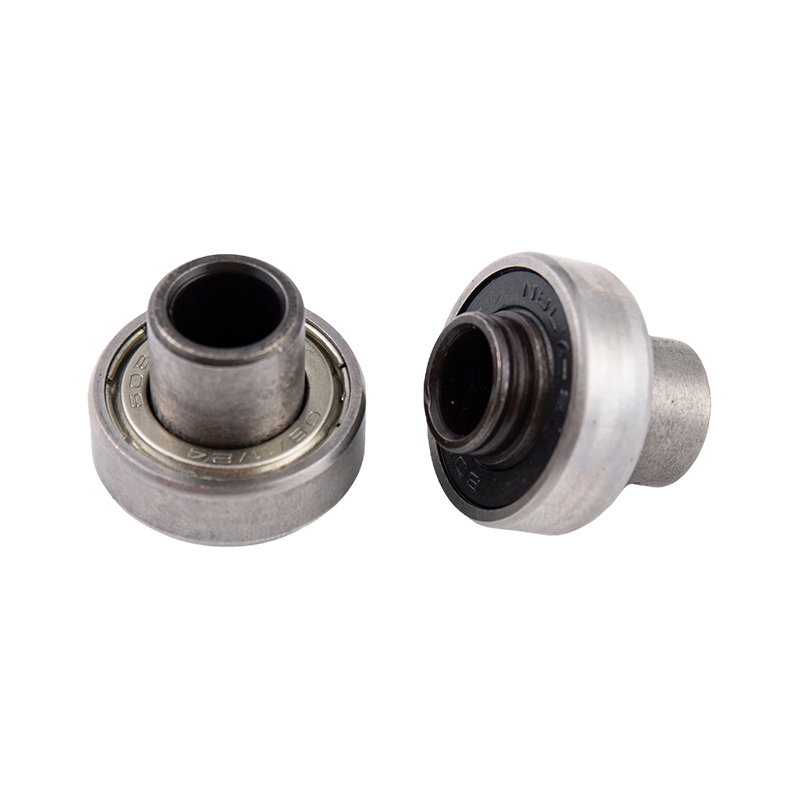 608RS Integrated Cart Accessory Bearing (150/300 kg)This compact, integrated 608RS bearing is built into trolley wheels, rated for 150 or 300 kg loads. It offers low rolling resistance and quiet operation, ideal for hand carts, food service, and equipment casters.View Product →
Frequently Asked Questions
Q1: Can I select a bearing using only the dynamic load rating?
No. The dynamic rating alone ignores peak loads that occur while the bearing is stationary. A bearing with a high C value can still fail from brinelling if the static load exceeds C0 during parking or under shock events.
Q2: What happens if the static load rating is exceeded?
Permanent deformation forms at the contact surfaces between the rolling elements and raceways. This damage appears as vibration, noise, increased friction, and shorter service life even after normal operation resumes.
Q3: How do I calculate the equivalent load from radial and axial forces?
Use the bearing manufacturer's formula, typically P = XFr + YFa, where Fr and Fa are the radial and axial load components, and X and Y are factors that depend on the bearing type and the ratio of axial to radial load.
Conclusion
Dynamic and static load ratings answer different questions. The dynamic rating predicts how long a rotating bearing will run before fatigue develops, while the static rating protects the bearing from permanent deformation when it is stationary or under shock. Reliable bearing selection for material handling equipment requires both values to be checked against actual duty cycles, peak loads, and safety factors.
To compare specifications and explore suitable options for your next project, visit Lanyue Metal and review the rolling bearing and component documentation.
Related Products

PRODUCTS
Carbon Steel Fastenerss Rolling Bearings Heavy-Duty Steel Folding Trolleys Swivel Casters Bolt kitsContact
 1st Floor, Building 4, East Side, Jinger Road, Yuxin Town, Nanhu District, Jiaxing City, Zhejiang Province, China
 [email protected][email protected]
 +86-137 0583 8919+86-135 8638 0656
Copyright © Jiaxing Lanyue Metal Technology Co., Ltd. All Rights Reserved.
Privacy
Custom High-Performance Industrial Fasteners Manufacturers, Suppliers
