-
 Lanyue Metal Technology
-
 [email protected]/[email protected]
-
 24 Hour Service - 7 Days a Week

 English
  Español
  Deutsch

Industry News
Industry News
Jun 23,2026
Carbon Steel Hex Nuts: Property Classes, Standards & Coatings Guide
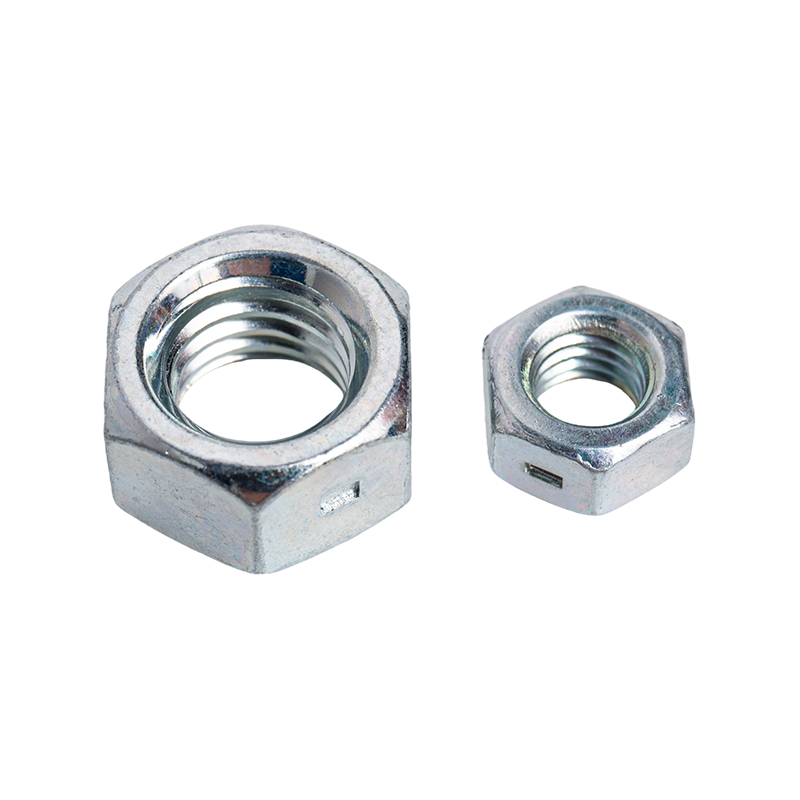
A carbon steel hexagonal nut is defined by three things that determine whether it's suitable for a given application: the steel grade and carbon content, the property class that indicates tensile and proof load strength, and the surface finish that protects it from corrosion. Mixing up any of these — particularly pairing a low property class nut with a high-strength bolt — is one of the most common and dangerous errors in fastener selection.
Content
Carbon Content and Steel Grade Determine Base Mechanical Properties
Carbon steel nuts are typically made from low to medium carbon steel, with carbon content generally falling between 0.13% and 0.55% depending on the strength grade required. Low-carbon steels (around 0.13–0.20% carbon) are easier to cold-form and are used for standard-strength nuts, while medium-carbon steels (0.30–0.55%) are used where higher tensile strength is needed, often combined with heat treatment to achieve the final hardness.
Heat treatment plays a significant role for higher property classes — quenching and tempering increases hardness and tensile strength but can also increase brittleness if not properly controlled, which is why higher-grade nuts typically specify both a hardness range and a minimum/maximum limit rather than a single target value.
Property Classes and Matching Nuts to Bolt Grades
Under ISO metric standards (ISO 898-2), hex nuts are marked with a property class number that indicates the proof load stress the nut can withstand without permanent deformation. This number must be matched correctly against the bolt's property class to ensure the joint performs as designed — a nut with insufficient strength can strip or deform under load even if the bolt itself is rated correctly.
| Nut Property Class | Compatible Bolt Property Class | Typical Application |
|---|---|---|
| Class 5 | 4.6, 4.8, 5.6, 5.8 | General fabrication, light machinery |
| Class 8 | 8.8 | Structural steelwork, automotive components |
| Class 10 | 10.9 | High-stress structural connections, heavy equipment |
| Class 12 | 12.9 | High-performance machinery, precision assemblies |
As a practical rule, the nut's property class number should be equal to or greater than the first digit (or the whole number portion) of the bolt's property class to ensure the nut doesn't become the weak point in the assembly.
Dimensional Standards: DIN, ISO, and ANSI Differences
Hex nut dimensions are governed by several overlapping standards, and mixing standards within an assembly can cause fit issues even when nominal thread sizes appear to match. DIN 934 and ISO 4032 are widely used metric standard hex nut specifications and are largely interchangeable for general applications, while DIN 6923 and ISO 4161 define hex flange nuts that integrate a washer-like flange to distribute load and resist loosening without a separate washer.
Key dimensional differences buyers should check include:
- Across-flats width (the wrench size) — generally consistent between DIN and ISO for the same nominal size, but ANSI/imperial nuts use a different sizing system entirely (e.g., 1/2"-13 UNC vs M12)
- Nut height/thickness — standard hex nuts and thin (jam) nuts differ significantly in height, with jam nuts typically used as locking nuts or where space is limited
- Thread pitch — coarse pitch threads are standard for general use, while fine pitch threads offer finer adjustment and slightly higher resistance to loosening under vibration
- Chamfer angle on the bearing face — affects how the nut seats against the mating surface and contributes slightly to the overall load distribution
Surface Finishes and Coatings for Corrosion Protection
Bare carbon steel nuts are highly susceptible to rust, so surface treatment is almost always specified for anything beyond indoor, low-humidity use. The coating choice affects not only corrosion resistance but also the friction coefficient during installation, which can influence the actual clamping force achieved at a given torque value.
- Zinc plating (electroplated): Provides moderate corrosion resistance and a bright finish, but the coating is relatively thin and can wear during installation in tight-tolerance threads.
- Hot-dip galvanizing: Produces a much thicker zinc layer offering significantly better long-term corrosion resistance for outdoor and structural applications, though the added thickness sometimes requires oversized internal threads to maintain assembly clearance.
- Black oxide: Provides minimal corrosion protection on its own and is typically used with supplemental oil for mild rust resistance combined with a low-glare appearance.
- Dacromet / geomet coatings: Zinc-flake based coatings offering high corrosion resistance with a thin, consistent layer that doesn't significantly affect thread fit — common in automotive applications.
For applications combining carbon steel nuts with bolts of a different metal — such as stainless steel bolts in a carbon steel nut — galvanic corrosion between the dissimilar metals can become a concern in humid or outdoor environments, and a compatible coating or isolation method should be specified accordingly.
Related Products


PRODUCTS
Carbon Steel Fastenerss Rolling Bearings Heavy-Duty Steel Folding Trolleys Swivel Casters Bolt kitsContact
 1st Floor, Building 4, East Side, Jinger Road, Yuxin Town, Nanhu District, Jiaxing City, Zhejiang Province, China
 [email protected][email protected]
 +86-137 0583 8919+86-135 8638 0656
Copyright © Jiaxing Lanyue Metal Technology Co., Ltd. All Rights Reserved.
Privacy
Custom High-Performance Industrial Fasteners Manufacturers, Suppliers
