
 English
  Español
  Deutsch
 Home / News / Industry News / Carbon Steel Hexagonal Nut: Grades, Standards, Dimensions & Sourcing Guide
-
 Lanyue Metal Technology
-
 [email protected]/[email protected]
-
 24 Hour Service - 7 Days a Week


Industry News
Home / News / Industry News / Carbon Steel Hexagonal Nut: Grades, Standards, Dimensions & Sourcing Guide
Industry News
Apr 09,2026
Carbon Steel Hexagonal Nut: Grades, Standards, Dimensions & Sourcing Guide
Content
- 1 Carbon Steel Hexagonal Nuts: Function, Geometry, and Industrial Importance
- 2 Carbon Steel Grades Used in Hexagonal Nut Manufacturing
- 3 Property Classes and Mechanical Requirements
- 4 Dimensional Standards and Hex Nut Types
- 5 Surface Treatments and Corrosion Protection
- 6 Procurement Specifications and Quality Verification
Carbon Steel Hexagonal Nuts: Function, Geometry, and Industrial Importance
A carbon steel hexagonal nut is a six-sided internally threaded fastener designed to mate with a bolt, screw, or threaded rod to clamp two or more components together. The hexagonal geometry provides six wrench engagement faces, allowing standard open-end, box, and socket wrenches to apply installation torque from any of three approach angles—a practical advantage in congested assemblies where tool access is restricted. Carbon steel is the dominant material for hexagonal nut production globally, accounting for the overwhelming majority of nuts used in construction, machinery, automotive, and infrastructure applications, due to its combination of mechanical strength, machinability, and cost efficiency relative to stainless steel and non-ferrous alternatives.
The load-bearing mechanism of a hexagonal nut depends on thread engagement length, which determines how the clamping force is distributed across the engaged thread flanks. A standard full hex nut typically provides a thread engagement length equal to approximately 0.8–1.0 times the nominal bolt diameter—sufficient to develop the full proof load of the mating bolt in the same property class without thread stripping under design load conditions.
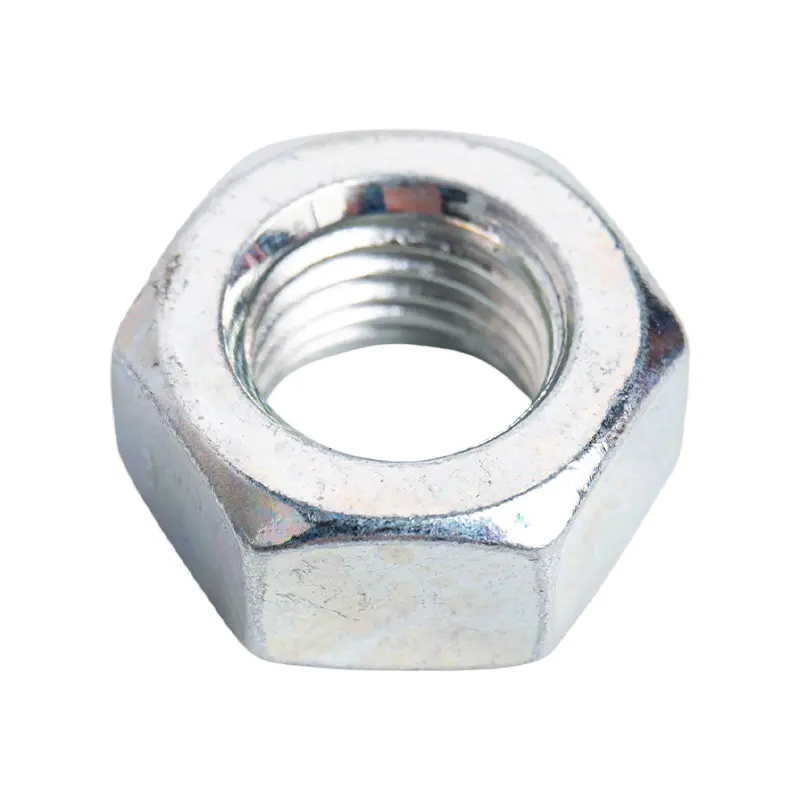
Carbon Steel Grades Used in Hexagonal Nut Manufacturing
The mechanical performance of a carbon steel hexagonal nut is determined primarily by the steel grade and any heat treatment applied during or after forming. Hexagonal nuts are produced from a range of carbon steel compositions, each suited to different strength class requirements and manufacturing processes.
- Low carbon steel (C ≤ 0.25%) — The most widely used material for standard hex nuts in property classes 4, 5, and 6. Low carbon grades such as AISI 1008, 1010, and 1018 are cold-formed and tapped without heat treatment, producing nuts with proof loads adequate for general-purpose structural and mechanical applications. Their low carbon content makes them highly weldable and resistant to hydrogen embrittlement—an advantage in electroplating processes.
- Medium carbon steel (C 0.25–0.55%) — Used for hex nuts in property classes 8 and 10, where higher proof loads require quench-and-temper heat treatment after forming. Grades such as AISI 1035, 1040, and 1045 develop tensile strengths of 800–1,040 MPa after heat treatment, enabling these nuts to be used with high-strength bolts in structural steel connections, heavy machinery, and pressure vessel assemblies.
- Medium carbon alloy steel — Boron-alloyed or manganese-chromium steels such as 10B21, 35B2, and SCM435 are used for the highest property class hex nuts (class 12 and above). Alloying elements improve hardenability, allowing larger nut cross-sections to achieve uniform hardness after quenching—a requirement that plain medium carbon grades cannot meet in nut sizes above M24 due to insufficient through-hardening depth.
Property Classes and Mechanical Requirements
Carbon steel hexagonal nuts are classified by property class under ISO 898-2, which defines proof load, hardness, and material requirements for each class. The property class system allows engineers to specify nuts that are correctly matched to bolt strength grades, ensuring that under proof load the nut thread strips before the bolt fractures—the failure mode that preserves bolt integrity and allows the joint to be detected and repaired.
| Property Class | Proof Load Stress (MPa) | Vickers Hardness Range | Matching Bolt Grade | Typical Steel Grade |
|---|---|---|---|---|
| 4 | 510 | 188 max | 3.6 / 4.6 / 4.8 | AISI 1008–1018 |
| 5 | 580 | 130–302 | 5.6 / 5.8 | AISI 1018–1022 |
| 6 | 600 | 150–302 | 6.8 | AISI 1022–1035 |
| 8 | 800 | 160–302 | 8.8 | AISI 1035–1045 (Q&T) |
| 10 | 1,040 | 170–353 | 10.9 | Alloy steel (Q&T) |
| 12 | 1,150 | 183–353 | 12.9 | Alloy steel (Q&T) |
A frequently misunderstood point in nut specification is that a higher property class nut can always be substituted for a lower class without affecting joint integrity, provided the nut thread and dimensions are identical. The reverse is not true: using a class 5 nut on a class 8.8 bolt creates a thread-stripping risk under proof load that is not detectable through visual inspection of the assembled joint.
Dimensional Standards and Hex Nut Types
Carbon steel hexagonal nuts are produced to dimensional standards that govern thread pitch, width across flats (wrench size), width across corners, bearing face diameter, and nut height. The two dominant international dimensional standards are ISO 4032 (regular hex nut, style 1) and ISO 4033 (high hex nut, style 2), with ASME B18.2.2 governing the North American market. DIN standards—particularly DIN 934—remain widely referenced in European industrial procurement despite being technically superseded by ISO equivalents.
- Regular hex nut (ISO 4032 / DIN 934) — The standard nut height is approximately 0.8 times the nominal thread diameter (e.g., an M12 regular nut has a nominal height of 10.0 mm). This geometry provides full proof load capacity when used with property class-matched bolts and is the correct choice for the majority of structural and mechanical applications.
- High hex nut (ISO 4033) — Nut height is approximately 1.0 times the nominal thread diameter, providing increased thread engagement for applications with elevated vibration, shock loading, or where the bolt material has lower tensile strength than the matching grade. High nuts are standard in railway track fastening and heavy civil engineering connections.
- Thin hex nut / jam nut (ISO 4035 / DIN 439) — Height approximately 0.5 times nominal diameter, used as a locking element in conjunction with a full nut, or in applications with restricted axial space. Thin nuts have reduced proof loads compared to regular nuts of the same thread size and should not be used as the primary load-bearing nut without engineering verification.
- Heavy hex nut (ASME B18.2.2 / ASTM A563) — Wider across flats and taller than standard hex nuts of the same thread size, heavy hex nuts are used in structural steel construction under AISC specifications and in ASME pressure vessel and piping applications where larger bearing face area reduces gasket and flange face stress concentration.
- Prevailing torque hex nut (ISO 7042 / DIN 980) — An all-metal locking nut with a distorted or out-of-round thread section at the top of the nut that creates interference with the bolt thread, generating prevailing torque that resists vibration loosening without requiring a separate locking element. Suitable for high-temperature applications where nylon insert nuts cannot be used.
Surface Treatments and Corrosion Protection
Carbon steel has inherently limited corrosion resistance and requires surface treatment for any application involving moisture exposure. The choice of surface treatment affects not only corrosion performance but also the coefficient of friction under the nut bearing face and on the thread flanks—directly influencing the relationship between applied installation torque and achieved bolt preload.
- Electrogalvanizing (zinc electroplating) — Zinc deposited at 5–12 µm thickness per ISO 4042 provides moderate corrosion protection, typically 72–120 hours salt spray resistance to first red rust per ISO 9227. The thin, uniform deposit maintains thread tolerances within ISO 6H/6g class without requiring thread allowance compensation. Chromate passivation post-treatment extends salt spray performance to 200–500 hours depending on passivate type. The dominant surface treatment for general-purpose hex nuts in indoor and light outdoor applications.
- Hot-dip galvanizing (HDG) — Immersion in molten zinc at 450°C deposits a zinc-iron alloy coating of 45–85 µm that provides substantially greater corrosion protection than electroplating—typically 1,000–2,000 hours salt spray resistance. The coating thickness requires nuts to be tapped oversize after galvanizing (tolerance class 6AZ per ISO 965-4) to accommodate the coating on mating bolt threads. Standard for structural steel construction, utility hardware, and outdoor infrastructure applications with 25–50 year design service life requirements.
- Mechanical zinc plating — Zinc powder is tumbled onto the nut surface with glass bead impact media, producing coatings of 10–25 µm without the hydrogen embrittlement risk associated with electroplating. Particularly specified for high-strength nuts (property class 10 and above) where electroplating-induced hydrogen embrittlement is a documented failure mode.
- Dacromet / geomet (zinc-aluminum flake coating) — Water-based inorganic coating systems containing zinc and aluminum flakes in a silica binder, applied at 8–12 µm and cured at 300°C. Provide 480–1,000 hours salt spray resistance at film thicknesses that do not significantly affect thread tolerance, and contain no hexavalent chromium—meeting RoHS and ELV directive requirements. Widely used in automotive underbody fasteners and agricultural machinery.
- Black oxide — A conversion coating that produces a black magnetite (Fe₃O₄) layer of 1–2 µm on the steel surface. Provides minimal corrosion resistance (24–48 hours salt spray) and is used primarily for aesthetic purposes or for low-humidity indoor applications where a dark appearance is specified. Often applied with oil post-treatment to improve short-term corrosion protection.
Procurement Specifications and Quality Verification
Sourcing carbon steel hexagonal nuts for industrial, construction, or OEM applications requires a procurement specification that goes beyond nominal thread size and property class. The following parameters should be explicitly defined in purchase documentation to prevent the delivery of non-conforming product that passes visual inspection but fails under load or environmental exposure.
- Dimensional standard and tolerance class — Specify the governing dimensional standard (ISO 4032, DIN 934, ASME B18.2.2, or equivalent), thread tolerance class (ISO 6H is standard for metric nuts), and any special dimensional requirements such as bearing face flatness or chamfer angle that differ from the standard.
- Material certification (mill certificate / test report) — For property class 8 and above, require a material test report (MTR) from the steel mill confirming chemical composition and mechanical properties of the heat used for production. ISO 9001-certified fastener manufacturers maintain traceability from finished nut to steel coil heat number as a standard quality system requirement.
- Proof load test frequency — Specify the sampling plan and acceptance criteria for proof load testing per ISO 898-2. For critical structural applications, require 100% proof load testing or a statistically valid AQL sampling plan with documented results rather than relying solely on manufacturer's declaration of conformity.
- Hydrogen embrittlement testing — For electroplated hex nuts in property class 10 and above, specify sustained load testing per ISO 15330 or ASTM F606 to verify that the plating and baking process has not introduced hydrogen embrittlement susceptibility. This test is not routinely performed by all fastener suppliers and must be explicitly required.
- Lot traceability and marking — ISO 898-2 requires property class marking on hex nuts M5 and larger. Verify that nuts are correctly marked with property class numerals on the bearing face or hex flat, and that lot numbers on packaging correspond to test certificates provided. Counterfeit fasteners—particularly in higher property classes—are a documented supply chain risk in commodity fastener markets and are most effectively detected through lot-traceable procurement combined with periodic third-party laboratory verification testing.
For large-volume procurement of carbon steel hexagonal nuts destined for structural or safety-critical applications, conducting a pre-shipment inspection (PSI) through an accredited third-party inspection agency—covering dimensional verification, hardness testing, and proof load sampling—before release of payment provides meaningful protection against the delivery of substandard product that visual inspection alone cannot identify.
Related Products


PRODUCTS
Carbon Steel Fastenerss Rolling Bearings Heavy-Duty Steel Folding Trolleys Swivel Casters Bolt kitsContact
 1st Floor, Building 4, East Side, Jinger Road, Yuxin Town, Nanhu District, Jiaxing City, Zhejiang Province, China
 [email protected][email protected]
 +86-137 0583 8919+86-135 8638 0656
Copyright © Jiaxing Lanyue Metal Technology Co., Ltd. All Rights Reserved.
Privacy
Custom High-Performance Industrial Fasteners Manufacturers, Suppliers
