-
 Lanyue Metal Technology
-
 [email protected]/[email protected]
-
 24 Hour Service - 7 Days a Week

 English
  Español
  Deutsch

Industry News
Industry News
Mar 13,2026
Carbon Steel Fasteners: Hex Nuts, Screws & Specifications
Carbon steel fasteners—including carbon steel hexagonal nuts, hex nuts, and hexagon screws—are the most widely specified fastener category in structural, mechanical, and industrial engineering because they offer an optimum combination of tensile strength, machinability, and cost efficiency that no other common fastener material replicates at scale. The hexagonal geometry is not merely conventional: it provides the maximum number of wrench engagement faces in the smallest material envelope, enabling reliable torque application in confined assemblies. Selecting the correct carbon steel grade, property class, dimensional standard, and surface coating for a given application determines whether a fastener assembly performs reliably for its design life or becomes a maintenance liability. This guide covers everything needed to specify, source, and install carbon steel hex fasteners correctly.
Content
- 1 Why Carbon Steel Dominates Fastener Manufacturing
- 2 Carbon Steel Property Classes: Understanding Strength Grades
- 3 Carbon Steel Hexagon Screws: Types, Standards, and Dimensional Specifications
- 4 Carbon Steel Hexagonal Nut and Hex Nut: Types and Selection
- 5 Surface Coatings and Corrosion Protection for Carbon Steel Fasteners
- 6 Torque and Preload: Getting the Most from Carbon Steel Hex Fasteners
- 7 Common Specification Mistakes and How to Avoid Them
Why Carbon Steel Dominates Fastener Manufacturing
Carbon steel—iron alloyed with carbon in concentrations ranging from 0.05% to 1.0%—is the foundational material for the global fastener industry. Approximately 70–75% of all fasteners produced worldwide are made from carbon steel, a market share that reflects the material's unique combination of properties relevant to fastener performance.
Mechanical Properties That Matter for Fasteners
- Tensile strength: Carbon steel fasteners are available across a wide strength range—from 400 MPa (Property Class 4.6) to over 1,200 MPa (Property Class 12.9)—by varying carbon content and applying heat treatment. This range covers the full spectrum from light-duty structural connections to high-preload bolted joints in power generation and heavy machinery.
- Ductility: Carbon steel maintains meaningful elongation at break (typically 8–14% depending on grade), allowing fasteners to deform slightly under overload before fracture—providing visible warning of joint distress that brittle materials like hardened tool steel do not.
- Machinability and cold formability: Low and medium carbon steels can be cold-headed and thread-rolled at high production rates, enabling the automated manufacturing of millions of dimensionally consistent fasteners per day at competitive cost.
- Heat treatability: Higher carbon grades (0.35–0.55% C) respond to quench-and-temper heat treatment, enabling property class upgrades from 8.8 to 10.9 using the same base material with different thermal processing.
Carbon Steel vs Alternatives in Fastener Applications
Stainless steel fasteners offer better corrosion resistance but cost 3–6 times more than equivalent carbon steel fasteners and are limited to property classes up to 8.0 in austenitic grades—insufficient for high-preload structural bolting. Aluminum fasteners are lightweight but have tensile strength limited to approximately 300 MPa. Titanium fasteners combine high strength with low weight and excellent corrosion resistance, but at 10–20 times the cost of carbon steel, they are reserved for aerospace and motorsport applications. For general structural, automotive, agricultural, and industrial applications, carbon steel provides the best value proposition.
Carbon Steel Property Classes: Understanding Strength Grades
The ISO metric fastener system classifies bolt and screw strength by property class—a two-number code that encodes both minimum tensile strength and yield-to-tensile ratio directly in the designation. Understanding property class is the most important technical literacy skill for fastener specification.
How to Read a Property Class Designation
For a bolt marked 8.8: the first number (8) multiplied by 100 gives the minimum tensile strength in MPa (800 MPa). The second number (8) multiplied by the first number gives the yield strength ratio expressed as a percentage (8 × 10 = 80%), so minimum yield strength = 800 × 0.80 = 640 MPa. This system applies consistently across all ISO metric property classes.
| Property Class | Min. Tensile Strength (MPa) | Min. Yield Strength (MPa) | Carbon Content (approx.) | Heat Treatment | Typical Applications |
|---|---|---|---|---|---|
| 4.6 | 400 | 240 | 0.05–0.20% | None (as-forged) | Light structural, general fabrication |
| 5.8 | 500 | 400 | 0.15–0.35% | None or light anneal | Automotive body, light machinery |
| 8.8 | 800 | 640 | 0.25–0.55% | Quench and temper | Steel structures, heavy equipment, flanges |
| 10.9 | 1,040 | 940 | 0.35–0.55% | Quench and temper | Automotive powertrain, structural joints |
| 12.9 | 1,220 | 1,100 | 0.40–0.55% (alloy) | Quench and temper (alloy steel) | High-preload precision joints, tooling |
Nut Property Classes
Nuts use a single-number property class system. A nut's property class must equal or exceed the property class of the mating bolt to ensure the bolt shank reaches proof load before the nut threads strip. Common pairings: Class 8 nuts with 8.8 bolts; Class 10 nuts with 10.9 bolts; Class 12 nuts with 12.9 bolts. Using a Class 8 nut on a 10.9 bolt creates a mismatched assembly where nut thread stripping may occur before the bolt reaches design preload.
Carbon Steel Hexagon Screws: Types, Standards, and Dimensional Specifications
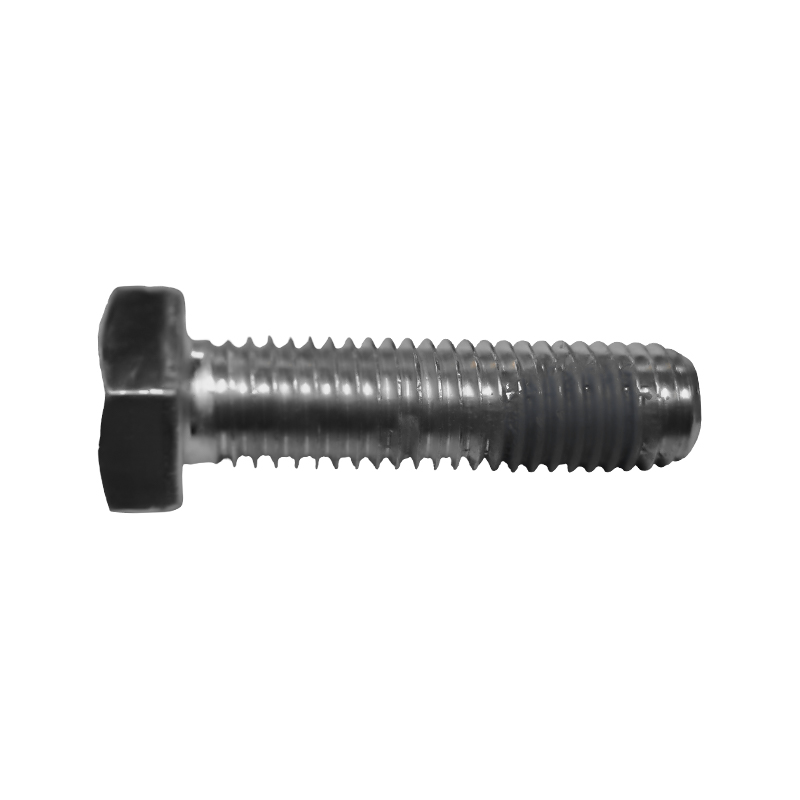
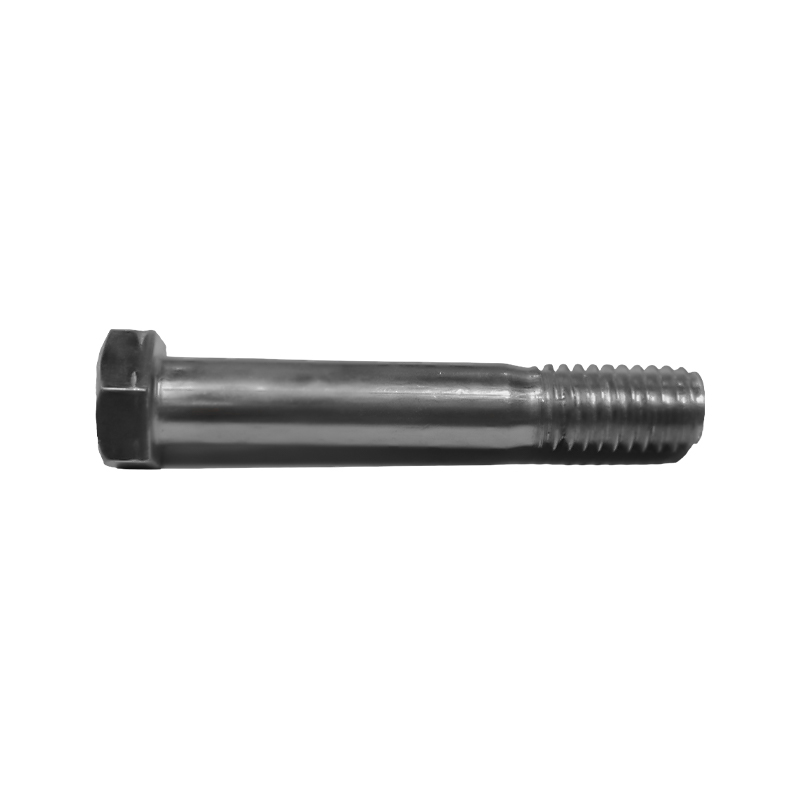
Carbon steel hexagon screws—also called hex cap screws or hex head bolts depending on dimensional tolerances and bearing surface finish—are the most frequently specified fastener geometry in structural and mechanical engineering. The hexagonal head provides six wrench flats for torque application, distributes bearing stress over a defined washer face area, and is manufacturable by cold heading and hot forging at all sizes from M3 to M100 and beyond.
ISO vs DIN vs ASME Standards for Hex Screws
Three primary dimensional standards govern carbon steel hexagon screws in global commerce. Understanding which standard applies to a specific application prevents costly dimensional incompatibilities:
- ISO 4014 / ISO 4017 (ISO metric): ISO 4014 covers hex bolts with partially threaded shanks; ISO 4017 covers fully threaded hex screws. These are the internationally dominant standards for metric fasteners, specifying thread pitch, head height, width across flats, and bearing surface dimensions. Property classes are marked on the head per ISO 898-1.
- DIN 931 / DIN 933: German standards that preceded the ISO standards and remain widely specified in European industrial machinery. DIN 931 (partially threaded) and DIN 933 (fully threaded) are dimensionally close to but not always interchangeable with ISO 4014/4017—head height and width across flats differ in some sizes. DIN-specified fasteners are still commonly stocked by European distributors.
- ASME B18.2.1 (inch series): Governs hex cap screws and hex bolts in the unified inch thread system (UNC/UNF). Grades are designated by SAE J429 (Grade 2, 5, 8) rather than property class. Used in North American markets and wherever UNC/UNF thread compatibility is required.
Full Thread vs Partial Thread: When to Specify Each
The choice between full-thread and partial-thread hex screws has significant structural implications:
- Partial thread (ISO 4014 / DIN 931): The unthreaded shank section passes through clearance holes in joined members, engaging threads only in the nut or tapped hole. The smooth shank provides a defined shear plane location and better resistance to transverse (shear) loading. Preferred for structural bolted connections, flange joints, and anywhere the bolt experiences combined tension and shear.
- Full thread (ISO 4017 / DIN 933): Threading extends to the underside of the head. Eliminates the need to match bolt length precisely to grip length and allows thread engagement at any point along the shank. Preferred for threaded-hole (tapped) applications, blind-hole assemblies, and where grip length variability requires flexibility.
Standard Dimensions for Common Metric Hex Screw Sizes
| Thread Size | Pitch (mm) | Width Across Flats (mm) | Head Height (mm) | Wrench Size (mm) |
|---|---|---|---|---|
| M6 | 1.0 | 10 | 4.0 | 10 |
| M8 | 1.25 | 13 | 5.3 | 13 |
| M10 | 1.5 | 17 | 6.4 | 17 |
| M12 | 1.75 | 19 | 7.5 | 19 |
| M16 | 2.0 | 24 | 10.0 | 24 |
| M20 | 2.5 | 30 | 12.5 | 30 |
| M24 | 3.0 | 36 | 15.0 | 36 |
Carbon Steel Hexagonal Nut and Hex Nut: Types and Selection
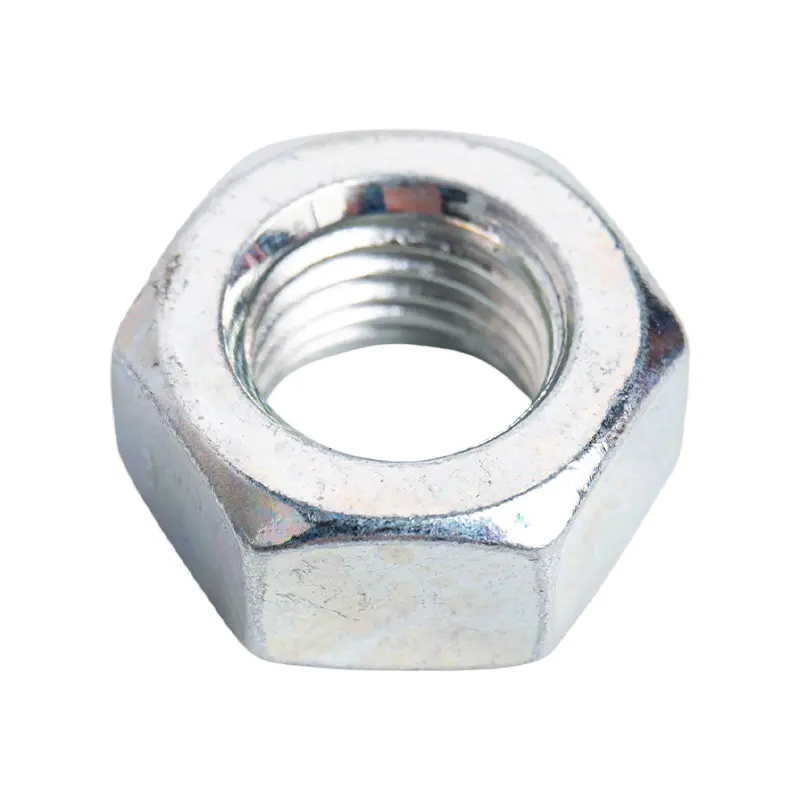
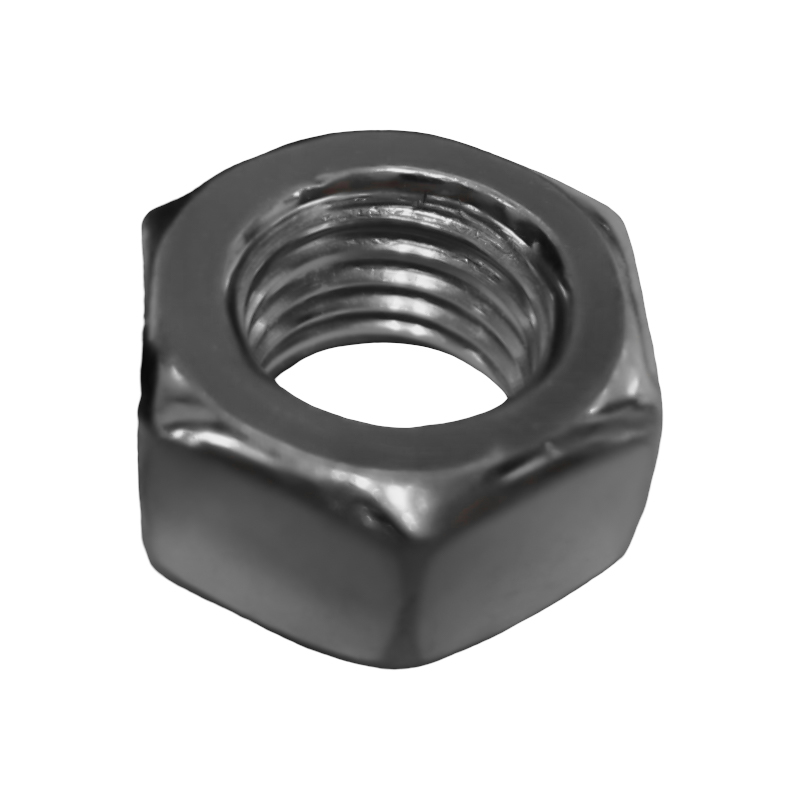
The terms "hexagonal nut" and "hex nut" refer to the same basic geometry—a six-sided internally threaded fastener—but encompass a range of subtypes distinguished by height, chamfer design, bearing surface finish, and intended load-bearing function. Selecting the appropriate nut type for a given application is as important as selecting the correct bolt grade.
Standard Hex Nut Types and Their Applications
- ISO 4032 Style 1 hex nut: The standard nut height (approximately 0.8 × nominal diameter). The most common specification for general structural and mechanical applications. Style 1 nuts are chamfered on both faces and carry a property class marking on the bearing face.
- ISO 4033 Style 2 hex nut: Approximately 10% taller than Style 1, providing greater thread engagement depth. Specified where enhanced resistance to thread stripping is required—typically with higher property class bolts (10.9, 12.9) in fatigue-loaded joints.
- ISO 4035 thin (jam) hex nut: Approximately half the height of a Style 1 nut. Used as a jam nut against a full nut to prevent loosening, or in assemblies with limited axial space. Not intended as a primary load-bearing nut.
- ISO 7042 all-metal prevailing torque nut: A distorted-thread locking nut that generates prevailing torque through thread deformation, providing vibration resistance without a separate locking element. Suitable for reuse up to 5 times before prevailing torque falls below specification.
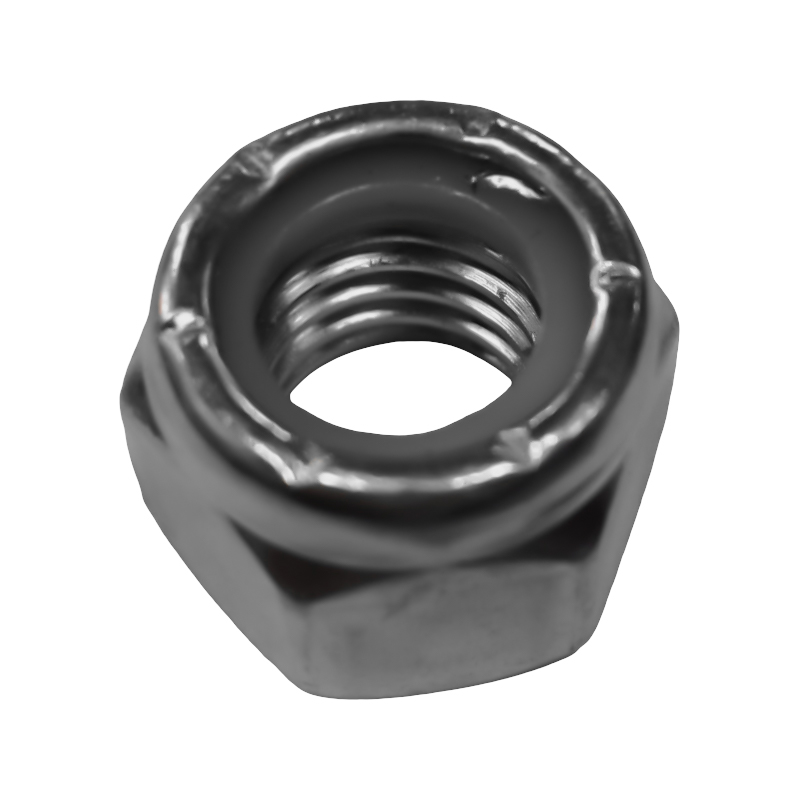
- ISO 7040 / 7041 nylon insert (Nyloc) nut: A standard hex nut body with a nylon insert that deforms around the bolt thread to generate prevailing torque. Provides excellent vibration resistance but is limited to service temperatures below 100–120°C due to nylon softening above this range.
- Heavy hex nut: Larger width across flats and greater height than standard hex nuts. Specified in ASME B18.2.2 for structural bolting applications (ASTM A325, A490 bolt assemblies) where the increased bearing area distributes load over a larger surface and reduces the risk of bearing-face yielding in softer base materials.
Thread Engagement and Nut Height: Why It Matters
The load capacity of a nut is directly determined by the number of engaged threads, which is a function of nut height. A standard Style 1 hex nut for M12 has a height of approximately 10.8 mm, providing roughly 6 thread pitches of engagement at 1.75 mm pitch. This is sufficient to develop full bolt tensile load in Property Class 8 combinations. For Property Class 10 and 12.9 nuts, the Style 2 height of approximately 12.0 mm provides the additional engagement depth needed to prevent thread stripping before bolt fracture.
Surface Coatings and Corrosion Protection for Carbon Steel Fasteners
Uncoated carbon steel corrodes readily in the presence of moisture and oxygen. Surface treatment selection is therefore as important as grade selection for any carbon steel fastener application outside of clean, dry indoor environments. Each coating type offers a different balance of corrosion protection, dimensional effect, temperature resistance, and cost.
Zinc Electroplating (Electrogalvanizing)
The most common carbon steel fastener coating for general indoor and light outdoor applications. Zinc layers of 5–12 µm (ISO 4042 Class A or B) provide sacrificial cathodic protection, where the zinc corrodes preferentially before the base steel. Salt spray life per ISO 9227 is typically 96–200 hours to red rust for standard zinc plating, extending to 500+ hours with chromate passivation (zinc + yellow chromate or zinc + trivalent chromate).
Critical limitation: Property Class 10.9 and 12.9 fasteners require controlled electroplating processes to avoid hydrogen embrittlement—atomic hydrogen absorbed during the plating bath can cause delayed fracture under sustained tensile load. Mandatory baking at 190–220°C for 4–24 hours after plating drives out absorbed hydrogen and is required by ISO 4042 for fasteners above Property Class 10.9.
Hot-Dip Galvanizing
Immersion in molten zinc at approximately 450°C produces a coating of 45–85 µm—significantly thicker than electroplating—providing substantially longer corrosion protection life. Hot-dip galvanized fasteners per ISO 10684 can achieve 1,000–2,000+ hours salt spray life and are the standard choice for outdoor structural applications including steel buildings, bridges, utility poles, and agricultural equipment.
The thick coating requires oversized nut tapping to maintain thread fit—hot-dip galvanized nuts must be ordered specifically as such, tapped to accommodate the zinc layer on the mating bolt. Mixing standard-tapped nuts with hot-dip galvanized bolts is a common specification error that causes galling and assembly difficulty in the field.
Mechanical Zinc Plating and Zinc Flake Coatings
Mechanical zinc plating (ISO 12683) applies zinc via tumbling with zinc powder and glass beads, achieving 10–30 µm without the hydrogen embrittlement risk of electroplating—making it suitable for high-strength fasteners. Zinc flake coatings (Geomet, Dacromet—per ISO 10683) apply a slurry of zinc and aluminum flakes baked at 200–300°C, achieving 500–1,000+ hours salt spray in 8–20 µm total thickness with zero hydrogen embrittlement risk. Zinc flake is the standard coating for automotive 10.9 and 12.9 fasteners in European OEM specifications.
Coating Selection Summary
| Coating Type | Thickness (µm) | Salt Spray Life (hrs) | H₂ Embrittlement Risk | Suitable for 10.9/12.9 | Relative Cost |
|---|---|---|---|---|---|
| Zinc electroplate | 5–12 | 96–500 | Yes (requires baking) | With baking only | Low |
| Hot-dip galvanize | 45–85 | 1,000–2,000+ | No | Up to 8.8 only | Moderate |
| Mechanical zinc plate | 10–30 | 200–720 | No | Yes | Low–Moderate |
| Zinc flake (Geomet/Dacromet) | 8–20 | 500–1,500 | No | Yes | Moderate–High |
| Black oxide | <1 | <50 (with oil) | Minimal | Yes | Low |
Torque and Preload: Getting the Most from Carbon Steel Hex Fasteners
The mechanical performance of a bolted joint depends on achieving the correct preload—the tension in the bolt shank created by tightening. Approximately 90% of applied torque is consumed overcoming friction under the nut and in the thread engagement zone; only about 10% generates useful bolt tension. This means that friction variation has a disproportionate effect on achieved preload for a given torque value.
Recommended Tightening Torques for Common Sizes
| Thread Size | Class 8.8 (Nm) | Class 10.9 (Nm) | Class 12.9 (Nm) |
|---|---|---|---|
| M8 | 25 | 35 | 41 |
| M10 | 49 | 69 | 81 |
| M12 | 86 | 120 | 140 |
| M16 | 210 | 295 | 350 |
| M20 | 420 | 590 | 690 |
| M24 | 720 | 1,020 | 1,190 |
These values are indicative for lightly oiled (µ ≈ 0.12) conditions. Dry or heavily corroded threads increase friction significantly, potentially requiring 30–50% higher torque to achieve the same preload. Always verify the friction coefficient assumption against actual joint conditions and consult the fastener manufacturer's engineering data for safety-critical applications.
Common Specification Mistakes and How to Avoid Them
Fastener failures in service are rarely caused by genuine material defects—far more frequently, they result from specification errors that are entirely preventable with careful upfront engineering.
- Mismatching nut and bolt property class: Using a Class 8 nut with a 10.9 bolt creates a strip-out risk before proof load is reached. Always specify nut property class equal to or one class above the bolt.
- Applying hot-dip galvanized bolts with standard-tapped nuts: The 45–85 µm zinc coating effectively increases the bolt's effective pitch diameter beyond standard nut thread tolerance. Use oversized-tapped nuts specified for galvanized assemblies.
- Specifying electroplated 12.9 fasteners without hydrogen embrittlement relief baking: Delayed hydrogen embrittlement fracture can occur days to weeks after assembly under sustained preload. Baking is mandatory per ISO 4042 and must be specified explicitly on the purchase order.
- Reusing single-use fasteners: Nyloc nuts lose prevailing torque rapidly after first removal. High-strength bolts used in structural friction-grip joints (ASTM A325, A490) are designated single-use. Reuse in safety-critical applications is prohibited by most structural codes.
- Confusing bolt length selection for full vs partial thread: For partial-thread bolts, the grip length (unthreaded shank) must equal or slightly exceed the total thickness of the joined members to ensure the thread starts in the nut, not in the joint interface. A bolt that is too short places the thread/shank transition at the shear plane—a stress concentration that significantly reduces fatigue life.
Related Products


PRODUCTS
Carbon Steel Fastenerss Rolling Bearings Heavy-Duty Steel Folding Trolleys Swivel Casters Bolt kitsContact
 1st Floor, Building 4, East Side, Jinger Road, Yuxin Town, Nanhu District, Jiaxing City, Zhejiang Province, China
 [email protected][email protected]
 +86-137 0583 8919+86-135 8638 0656
Copyright © Jiaxing Lanyue Metal Technology Co., Ltd. All Rights Reserved.
Privacy
Custom High-Performance Industrial Fasteners Manufacturers, Suppliers
